78 MPH and a Scarecrow: The Highway Mystery That Overtook Lane Three
By 6:14 a.m., the southbound carriageway had already developed the emotional texture of overcooked porridge. Commuters were braking for no visible reason, indicators blinked with the sincerity of broken lighthouses, and somewhere between Junction 11 and the service station with the suspiciously damp pasties, traffic reports began using the phrase “an unfolding rural incident.”
At the center of it all stood a scarecrow.
Not in a field, where one expects a scarecrow to be standing in professional silence, but upright in lane three of the M47, boots planted, hat fixed, jacket snapping in the wind like a man auditioning for weather. Witnesses say vehicles passed it at 78 mph while the figure remained “composed,” “judgmental,” and, according to one van driver, “somehow more official-looking than most temporary road signs.”
Police closed two lanes shortly after sunrise, though not before dozens of motorists had slowed to identify whether the object was a hazard, an installation, or “one of those modern campaigns against speeding that are meant to make you feel personally attacked.”
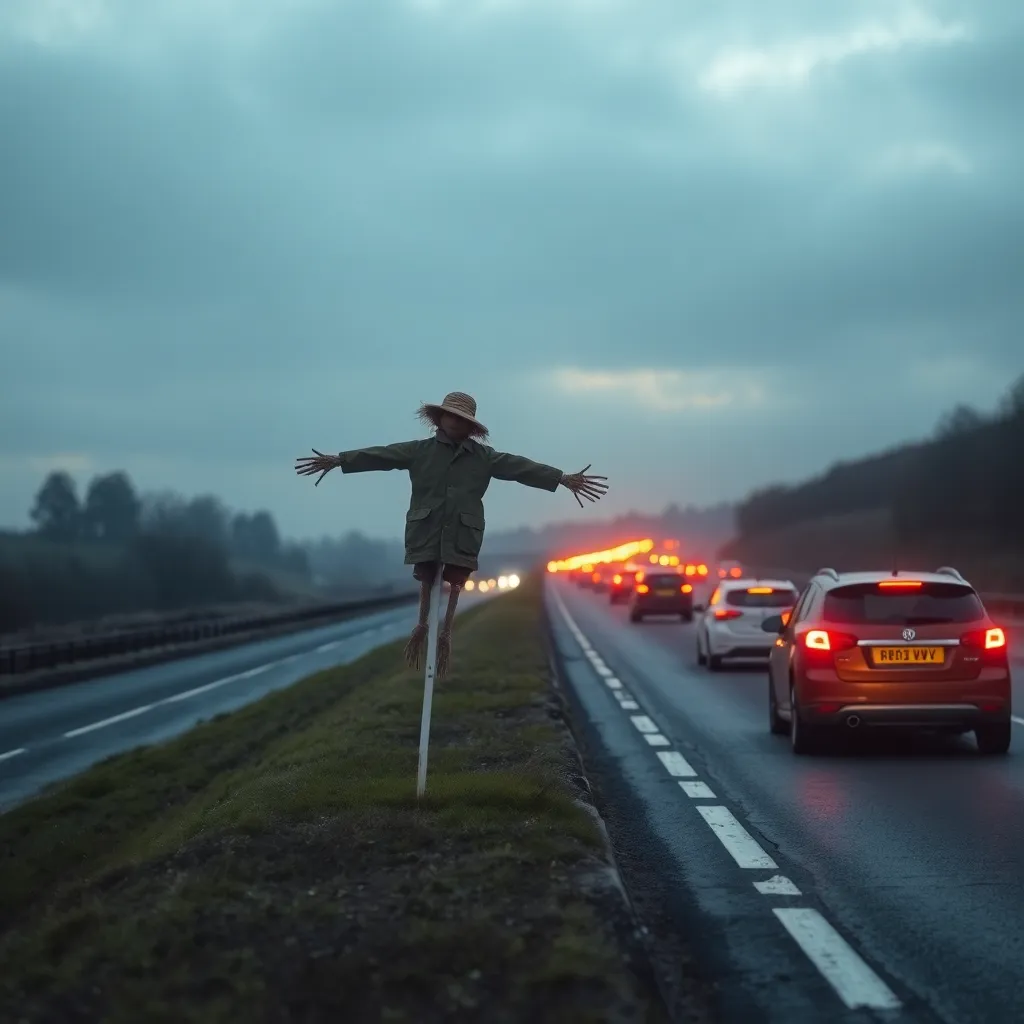
Authorities have so far declined to confirm the scarecrow’s exact point of origin, but theories have multiplied with the speed and nutritional confidence of a service-station sausage roll. One camp believes the figure blew in from a nearby farm during the night’s gusts, though farmers in the area have raised an eyebrow at this explanation, noting that while hats may travel, a fully assembled scarecrow rarely chooses to migrate in one piece unless “motivated by either theology or admin.”
Another theory suggests it fell from a flatbed truck transporting seasonal decorations. This gained momentum after a witness claimed to see “what looked like straw” scattered along the hard shoulder, although investigators later clarified this may also have been “the sort of shredded yellow packaging that appears whenever a lorry has a personal crisis.”
For 43 extraordinary minutes, the scarecrow became the most discussed figure in county transport. Drivers described an uncanny sensation upon passing it. “It wasn’t just there,” said accountant Martin Foyle, still visibly rattled in a lay-by interview. “It looked like it knew my car finance arrangement. I went by at 78 and somehow felt criticised for the state of my glove compartment.”
Others reported the object appeared to pivot slightly in the slipstream of passing vehicles, lending the impression it was surveying the scene with mounting disappointment. “I’ve been judged by in-laws, parking attendants, and a dentist named Clive,” said commuter Nisha Patel, “but I’ve never felt so thoroughly assessed by stitched burlap.”
What transformed the incident from routine obstruction into national fascination, however, was the question of placement. Experts in road safety have pointed out that the scarecrow was not merely on the motorway. It was very specifically in lane three, the lane generally reserved for overtaking, poor decisions, and hatchbacks conducting private arguments with physics.

“This wasn’t random drift,” declared amateur traffic sleuth and former parish quiz winner Len Dobson, who has since produced a laminated diagram of the area. “A scarecrow doesn’t simply bumble into lane three. It commits to lane three. It has a plan. It understands confidence. Frankly, I’ve seen less decisive merging from people in German saloons.”
The Department for Roads, Signals and Unfinished Cones issued a brief statement calling the event “highly unusual,” which by departmental standards is considered a volcanic outburst of feeling. Crews were dispatched to remove the figure, but not before a second wave of complications emerged: several motorists, seeing workers approach the scarecrow, slowed again in the belief they were witnessing either an arrest or the launch of a community art project.
One motorway maintenance worker, speaking through the strained dignity of a man who did not expect to wrestle straw before breakfast, said the retrieval itself was “surprisingly political.” According to him, the scarecrow had been anchored around the ankles with what appeared to be baler twine and part of a broken signpost. “Someone,” he said, pausing to stare into the middle distance, “wanted that scarecrow to hold its ground.”
This revelation has shifted public attention toward deliberate placement. In the nearby village of Crowthorpe, residents spent much of the morning denying involvement with the exhausted innocence of people who are absolutely involved in something, though not necessarily this. “We’re not vandals,” said one local man while standing beside a shed full of suspiciously empty fence hooks. “We’re a heritage-minded parish.”
Sources in the village suggest the scarecrow may have been constructed last autumn for the harvest procession and named Gerald. This has not been officially verified, but the name has spread rapidly enough that radio presenters are now referring to “the Gerald theory” as if discussing a constitutional matter.
Gerald, if Gerald he was, seems to have led a rich and textured existence. Several residents described a scarecrow in a navy blazer and old cricket tie who had previously stood outside the allotments “giving the impression of retired authority.” One woman recalled children saluting it on their way to school. Another said crows avoided it, not out of fear, but “professional respect.”
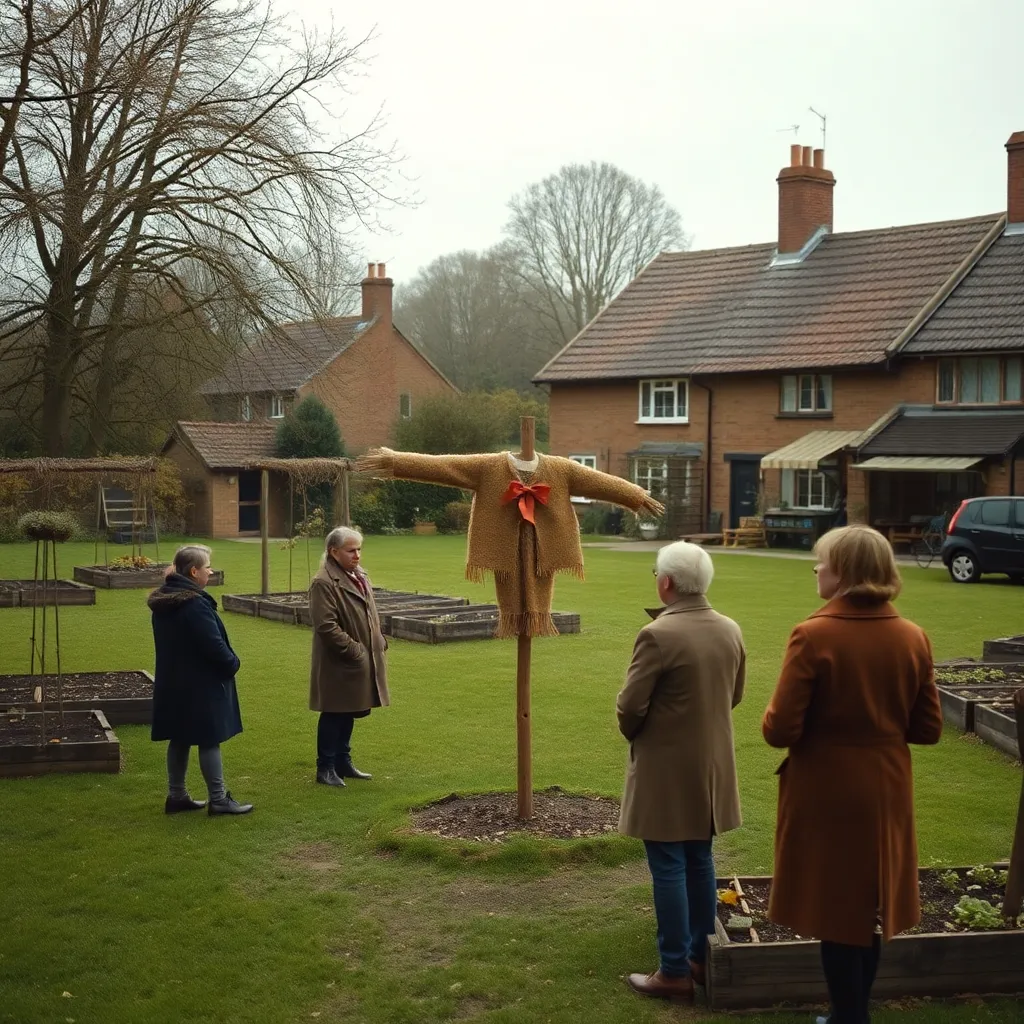
If true, this would mean the motorway scarecrow was not just debris, but a local personality with a social footprint and possibly opinions on begonias.
The speed element, meanwhile, continues to grip the public imagination. Why 78 mph? Traffic analysts stress that the scarecrow itself was stationary and that 78 mph refers to the speed at which many vehicles passed it before the closure. Yet this clarification has done little to dampen speculation that the number means something. Conspiracy-minded internet users have suggested a coded message. Numerologists have called it “agriculturally charged.” A man in a pub off the A-road announced to broad silence that 78 is “how fast truth travels when government is frightened of barley.”
There are also unresolved witness reports. Three drivers independently stated that the scarecrow’s right sleeve lifted as they passed, as if waving. Investigators attribute this to wind turbulence. A fourth motorist insists the figure pointed at him. This account is currently being treated as “emotionally true, though mechanically difficult.”
Motorway cameras captured enough footage to confirm the broad sequence of events but, infuriatingly, not enough to answer the central question of who put the scarecrow there. On one grainy clip, headlights sweep across the road and, in the next usable frame, the figure is simply present: abrupt, upright, and fully invested in causing paperwork.
This has led to the kind of fevered public theorising usually reserved for unidentified sea creatures and local council budgets. Was it a prank? A protest? A failed navigation experiment? One retired haulier argued the scarecrow may have been intended as “a symbolic intervention” against reckless driving. “Nothing encourages lane discipline,” he said, “like seeing agriculture where agriculture should not be.”
Insurance firms have watched the story with concern. One spokesperson admitted that, while policies contain extensive language about collisions with animals, weather events and accidental falling cargo, there remains “a regrettable grey area around purposeful straw officials.”
By noon, the motorway had reopened, the scarecrow had been removed to a storage depot, and the county had entered the reflective phase of any major incident, during which everyone becomes an expert and no one remembers overtaking quite so aggressively. Flowers have not yet been placed at the scene, though someone did leave a small bag of bird seed by the crash barrier, which police say they are “not currently treating as evidence.”
As for the scarecrow itself, reports indicate it is being kept in a secure municipal facility pending examination. An unnamed source described it as “well made, heavier than expected, and strangely formal around the shoulders.” There is talk of fingerprint dusting, fibre analysis and, in one ambitious corner of local government, the establishment of a temporary cross-agency Straw Working Group.
Until answers emerge, the mystery remains lodged in the public imagination like a traffic bulletin with unfinished business: how did a scarecrow come to command lane three, and why did so many people passing at 78 mph feel, if only for a second, that they were the ones being watched?
For now, Gerald has left the motorway, but not the conversation. Somewhere in a county evidence room, a hat is drying, a jacket is shedding bits of field, and a pair of hollow sleeves rest on a plastic chair with the serene authority of something that knows this story is not over.