Biologists Make Revolutionary Discovery of Sharks That Hunt Using Organically Grown Laser Arrays in Their Heads
By The Wibble Science Desk, filed from a coastal research facility that is definitely not on fire
Marine biologists have announced what they are calling “the most exciting scientific breakthrough since someone realised dolphins are smug on purpose”: a previously undocumented population of sharks that hunt prey using organically grown laser arrays embedded directly in their heads.
The sharks—provisionally named Carcharodon photonicus (pending a grant, a committee, and several fights)—were first observed off the coast of somewhere you can’t afford to vacation, after local fishermen reported “a red line under the water like a cat toy, except it was followed by screaming and a smell like microwaved calamari.”
“It’s Not Bioluminescence. It’s… Optics.”
The discovery was made by a team from the Institute for Advanced Marine Guessing, led by Dr. Naomi Blent, who described the moment her team realised they weren’t dealing with normal shark behaviour.
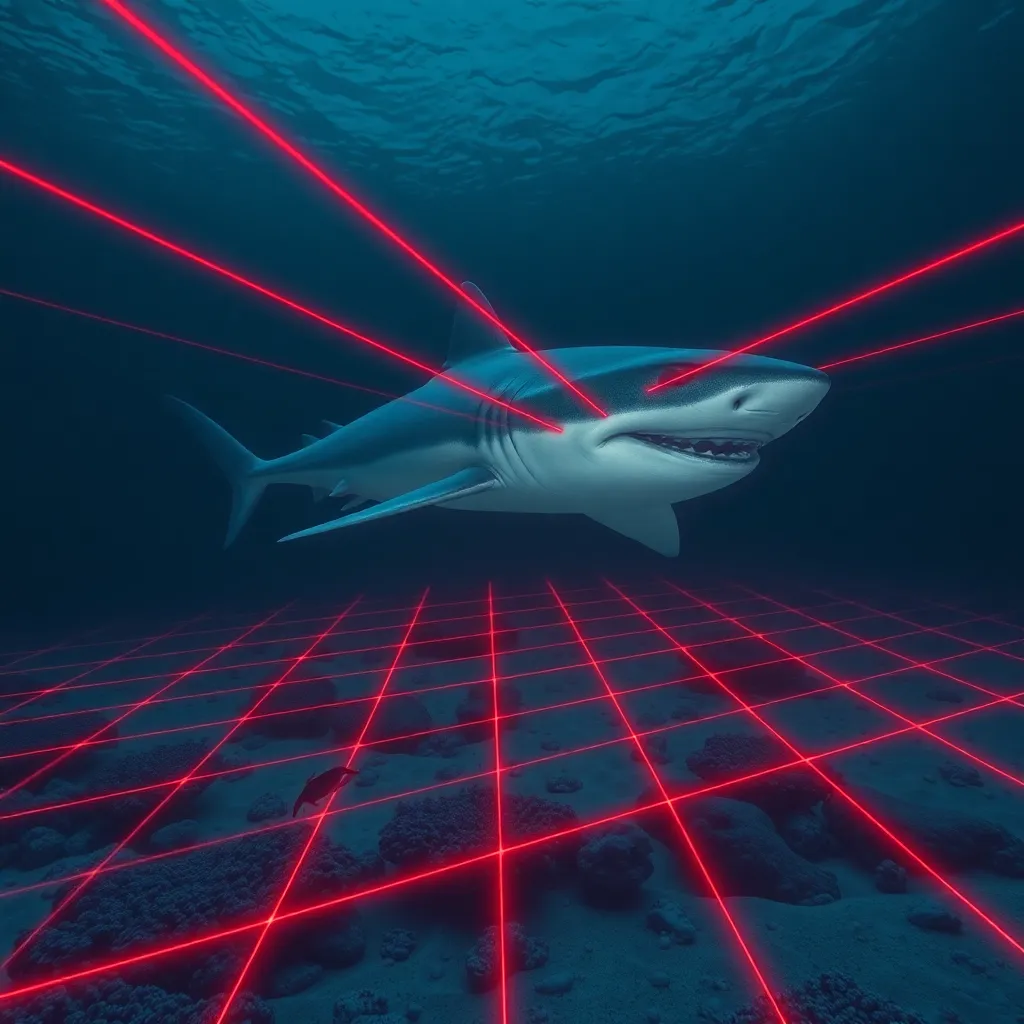
“We were tracking what we assumed was standard predation—circling, lunging, the usual aquatic murder,” said Dr. Blent. “Then we saw a precise lattice of thin, coherent beams scanning the seafloor in a perfect grid pattern. At first we thought it was a malfunctioning underwater barcode reader. But then a shark head rotated slightly and the beams adjusted with it. At that point our intern fainted in a very helpful way, because it confirmed this was unusual.”
Underwater footage shows the sharks hovering motionless before emitting what researchers have labelled a “polite but firm beam pattern,” seemingly mapping schools of fish like a supermarket self-checkout machine.
The fish, tragically, were not eligible for the “unexpected item in the bagging area” exemption.
The Laser Arrays: Free-Range, Gluten-Free, and Terrifying
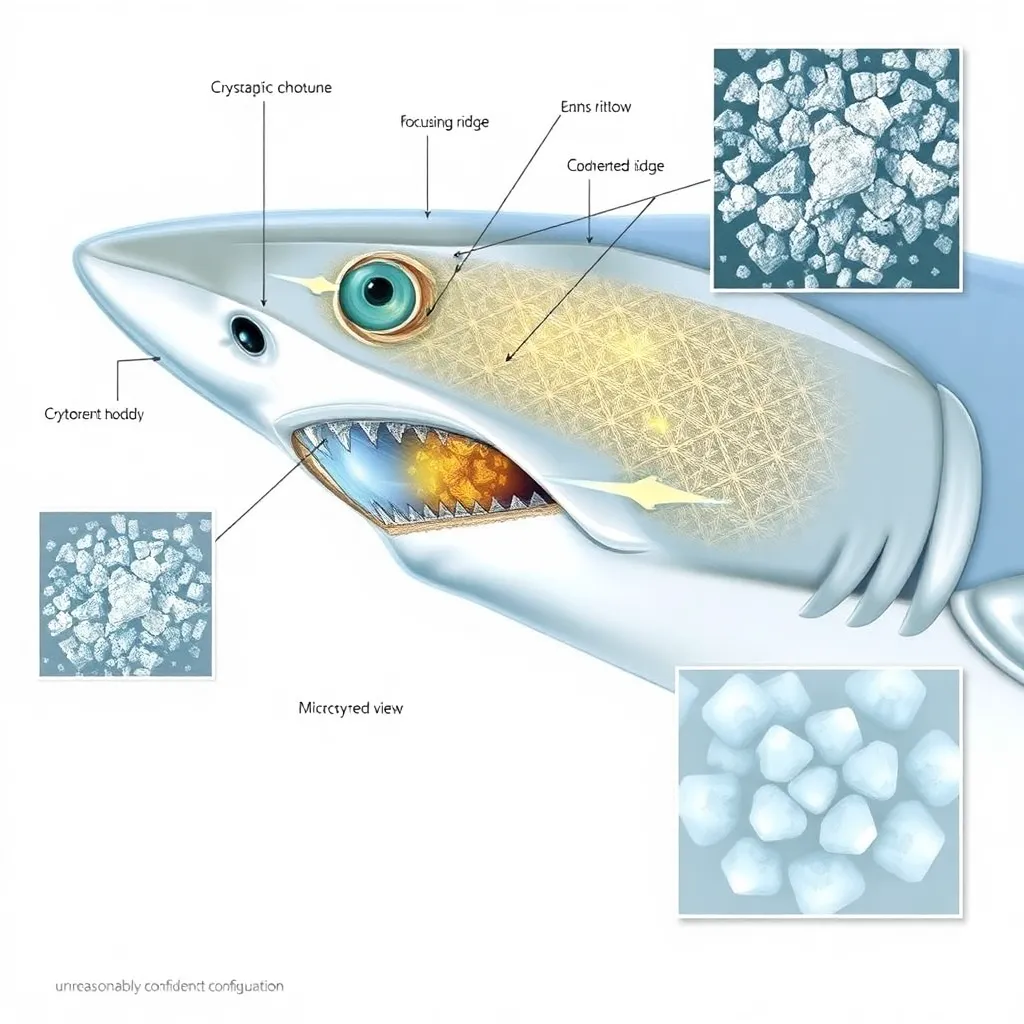
According to the team’s preliminary report, the laser structures are not technological implants, nor the work of sinister billionaires, nor the result of sharks stealing components from coastal Wi-Fi routers. Instead, they appear to be biological growths—specialised organ-like tissues that produce and focus light via microscopic crystalline structures arranged in what Dr. Blent called “an unreasonably confident configuration.”
“These are not crude beams,” she said. “They are coherent, directional, and embarrassingly efficient. If this shark applied for a job designing laser pointers, it would be overqualified.”
Researchers believe the arrays function similarly to a cross between a deep-sea anglerfish lure and a high-end home theatre projector, except weaponised and attached to something with teeth.
“People hear ‘organic lasers’ and assume it means they’re somehow artisanal,” explained evolutionary biologist Professor Harlan Vetch. “But organic just means they’re grown. This isn’t a farmer’s market. This is a precision death grid with fins.”
How the Sharks Use the Lasers (Yes, Really)
Scientists propose three main uses for the sharks’ head-mounted laser arrays:
Prey Detection and Rangefinding
The beams sweep through particulate-rich water, illuminating silhouettes and measuring distance with what one researcher called “the cold indifference of a parking sensor.”Disorientation
Some fish appear to freeze when hit by the light patterns, possibly due to sensory overload or the realisation they’ve become part of an interactive installation titled “You Are Dinner”.Communication
Several sharks were observed flashing beams at each other in rhythmic bursts. Researchers haven’t decoded the pattern yet, though one grad student believes it translates to: “Move. Mine.”
A fourth hypothesis—that the lasers are purely aesthetic—has not been ruled out.
“Evolution sometimes does things simply because it looks incredible,” said Professor Vetch. “Look at peacocks. Look at humans buying jeans with holes in them. Nature is not above a flex.”
The First Human Encounter: “It Looked at Me Like I Was a Sardine With Student Debt”
Divers conducting routine surveys reported unsettling interactions with the laser sharks, including what they described as “being scanned.”
“It hit me with this thin red line across my mask,” said diver and marine technician Luis Hammer. “It was like when someone’s about to present a PowerPoint and the laser pointer dot appears on your forehead. Except the presenter is a shark and the PowerPoint is your mortality.”
Hammer noted the shark seemed to hesitate, then swam away.
“I think my oxygen tank made me look too complicated,” he said. “Or maybe it sensed I hadn’t eaten in six hours and pitied me.”
The Big Question: How Did This Happen?
In a press conference held near a whiteboard filled with arrows, question marks, and an increasingly desperate drawing of a shark with a little laser hat, researchers outlined several theories for how such a trait could evolve:
Deep-sea light adaptation: Ancestors may have developed bioluminescent organs for signaling, later refined into directional beams.
Crystalline tissue mutation: Certain minerals in the sharks’ diet might have contributed to lens-like structures forming in cranial tissue.
Spite: A controversial but increasingly popular theory among exhausted field researchers.

“Sometimes the ocean just decides you haven’t been humbled enough,” said Dr. Blent. “And then it invents a shark that can do geometry.”
Environmentalists Concerned, Tech Executives Intrigued
The discovery has already sparked frantic interest from the private sector. Within hours, at least three tech CEOs reportedly attempted to purchase the sharks outright, believing them to be “nature’s prototype” for a new line of biodegradable tactical lighting.
One leaked email from a major tech firm described the laser sharks as “disruptive predators with scalable optics and strong brand synergy.”
Conservation groups have urged caution.
“We do not need a world where sharks are harvested for their built-in laser parts,” said marine conservationist Orla Dean. “We’ve already made enough mistakes. We turned wolves into handbags. Let’s not turn sharks into nightclub accessories.”
The Military’s Statement Was Somehow Worse
When asked whether military agencies had expressed interest, a spokesperson for a defence department replied: “We are always interested in marine innovations that can help keep our personnel safe,” before adding, “and also make the ocean more obedient.”
The spokesperson later clarified that the department was not currently pursuing “shark-based laser initiatives,” then immediately stopped returning calls.
Tourist Boards See an Opportunity
Several coastal towns have already begun rebranding, hoping to attract thrill-seekers and influencers.
One town council unveiled a promotional campaign titled “Come For The Beaches, Stay Because You’re Being Tracked”, featuring a smiling cartoon shark projecting a laser heart onto a paddleboarder.
A local gift shop has begun selling novelty swim goggles with a sticker reading: “I GOT SCANNED AND ALL I GOT WAS THIS SHIRT.”
What This Means for the Future of Marine Science (And Sleep)

Researchers are now racing to understand the sharks’ biology before the sharks decide to understand ours.
“We need funding for longer-term observation,” said Dr. Blent. “Also for replacement drones. Also for therapy.”
The team plans to publish their findings in the Journal of Unsettling Ocean Developments, though peer reviewers have reportedly asked whether the footage might be “a prank,” “a hoax,” or “a film trailer for something irresponsible.”
Dr. Blent remains firm.
“We have tissue samples,” she said. “We have spectral analysis. We have multiple confirmed sightings. And we have the lingering feeling that the ocean has been holding back until now.”
Public Reaction: Mostly Denial, Some Merch
Online, reactions ranged from disbelief to resigned acceptance.
“Sharks with lasers? Sure. Why not. It’s 2026.”
“This is what happens when you stop respecting the sea.”
“Do they come in different colours? Asking for a friend.”
“I knew it. I KNEW it. The ocean has been upgrading.”
Meanwhile, cat owners worldwide have expressed concern that the laser sharks may represent “unfair competition.”
Final Thoughts: Nature Has Read Too Much Science Fiction
Whether the laser arrays prove to be a rare mutation, a hidden species, or the ocean’s way of reminding humanity it is not the main character, one thing is clear: our planet remains committed to inventing new horrors in the most technically impressive way possible.
As Dr. Blent put it, staring at paused footage of a shark calmly projecting a perfect grid across a reef:
“It’s beautiful. It’s elegant. It’s a nightmare. And it’s definitely organic—because nothing man-made could be this spiteful without a meeting.”
For now, the Institute’s official recommendation is simple: admire from a distance, do not attempt to pet, and if you see a thin red line sweeping toward your ankles in the shallows, leave the water calmly—because somewhere beneath you, a shark is running diagnostics.