Chicken Leads Furious Roadside Uprising as QWERTY Alphabet Overhaul Collides With Escalating Ryzen Bitshift Emergency
Residents awoke yesterday to the unmistakable sound of civic unrest: one chicken, then several, then what witnesses described as “a highly coordinated feather parliament,” crossing the eastbound lanes of Market Bypass in apparent protest of the proposed QWERTY alphabet overhaul, a plan critics say would replace several beloved letters with “more agile premium consonants.”
The lead hen, known locally as Margaret Clucksworth, stepped into traffic at 8:14 a.m. with the grave composure of a pensioner returning soup at a deli. By 8:16, she had been joined by dozens of supporters carrying tiny placards made of bread crusts and receipt paper. Their demands were simple: preserve the current letter arrangement, stop moving vowels into subscription tiers, and explain why the letter R now allegedly requires firmware updates.

The unrest comes as the government’s embattled Department of Keyboard Modernisation and Public Spelling pushes ahead with its controversial reform package. Officials insist that the traditional alphabet, “while historically charming,” can no longer meet the demands of a high-speed society increasingly dependent on predictive text, ergonomic outrage, and what one white paper called “letter streamlining for tomorrow’s grunts.”
Under the proposal, the sequence known informally as QWERTY would be revised into a more “performance-oriented linguistic architecture,” though leaked drafts suggest this mainly involves relocating M “to improve workflow,” merging C and K into a single corporate syllable, and replacing the semicolon with what analysts have described as “a paid emotional punctuation token.”
Linguists have condemned the plan. Farmers have condemned the plan. Three brass bands have condemned the plan. The chickens, however, have gone further, arguing that a society willing to reshuffle its alphabet is only months away from assigning passwords to sunsets.
Complicating matters is the simultaneous deterioration of the Ryzen bitshift crisis, now entering its fourth week and spreading from server farms into ordinary households. Experts say the crisis began when several high-performance processors allegedly started “thinking diagonally,” causing bits to migrate left during routine operations and occasionally right “out of spite.” The result has been widespread digital confusion, including upside-down spreadsheets, resentful smart fridges, and one municipal parking meter that briefly achieved sentience before demanding coastal property.
At a hastily arranged press conference, Technology Minister Owen P. Lanyard attempted to reassure the public.
“There is no connection between the keyboard overhaul and the Ryzen bitshift crisis,” he said, standing before a projection that had somehow replaced all instances of the number 8 with a photo of an apricot. “Any suggestion that our national infrastructure is being held together by legacy punctuation and optimistic voltage settings is irresponsible.”
Minutes later, his prepared remarks were corrupted by a bitshift event, transforming the phrase stability remains our highest priority into staircase remains yogurt’s private monarchy, which several commentators described as “more honest than expected.”

On the bypass, tensions rose as negotiators attempted to open dialogue with the chickens using seed, soft tones, and laminated charts. The effort collapsed when a junior civil servant accidentally referred to the lead protester as “poultry-adjacent,” prompting angry clucking and a brief but decisive occupation of the turning lane.
“I asked one of them what they wanted,” said commuter Alan Dobb, still trapped in his hatchback six hours later. “It pecked the word accountability into the dust on my bonnet and then stared at me like I was personally responsible for autocorrect.”
The roadside demonstration has drawn support from a broad coalition that now includes anti-update pensioners, independent booksellers, two rogue typists, and a breakaway faction of software engineers calling themselves Mothers Against Involuntary Kernels. Together, they accuse the government of exploiting the Ryzen emergency to slip through radical orthographic changes while the nation’s devices are too disoriented to object.
At the centre of the panic is a confidential technical memo, leaked Tuesday, warning that if the bitshift crisis continues unchecked, the country could experience a Category 5 Syntax Event by the weekend. Such an event would likely produce sentence inversions, legally ambiguous weather forecasts, and dangerous instability in crossword grids nationwide.
One paragraph, largely redacted except for the words containment impossible, microwave laughter, and do not let the printers unionise, has done little to calm nerves.
The poultry movement’s symbolism has not gone unnoticed. Political historians point out that the chicken crossing the road has long occupied a controversial place in national mythology, often dismissed by elites as unserious despite its obvious logistical bravery. By converting the crossing into a mass action campaign, organisers have transformed a tired philosophical prompt into a full-bodied constitutional challenge with beaks.
Professor Len Gasket, Chair of Applied Semiotics at the University of Tring, called the protest “an extraordinary intervention in the politics of movement.”
“The chicken is no longer crossing the road to arrive somewhere,” he explained. “It is crossing to reject imposed destination frameworks. Also, it appears to be furious about keycaps.”
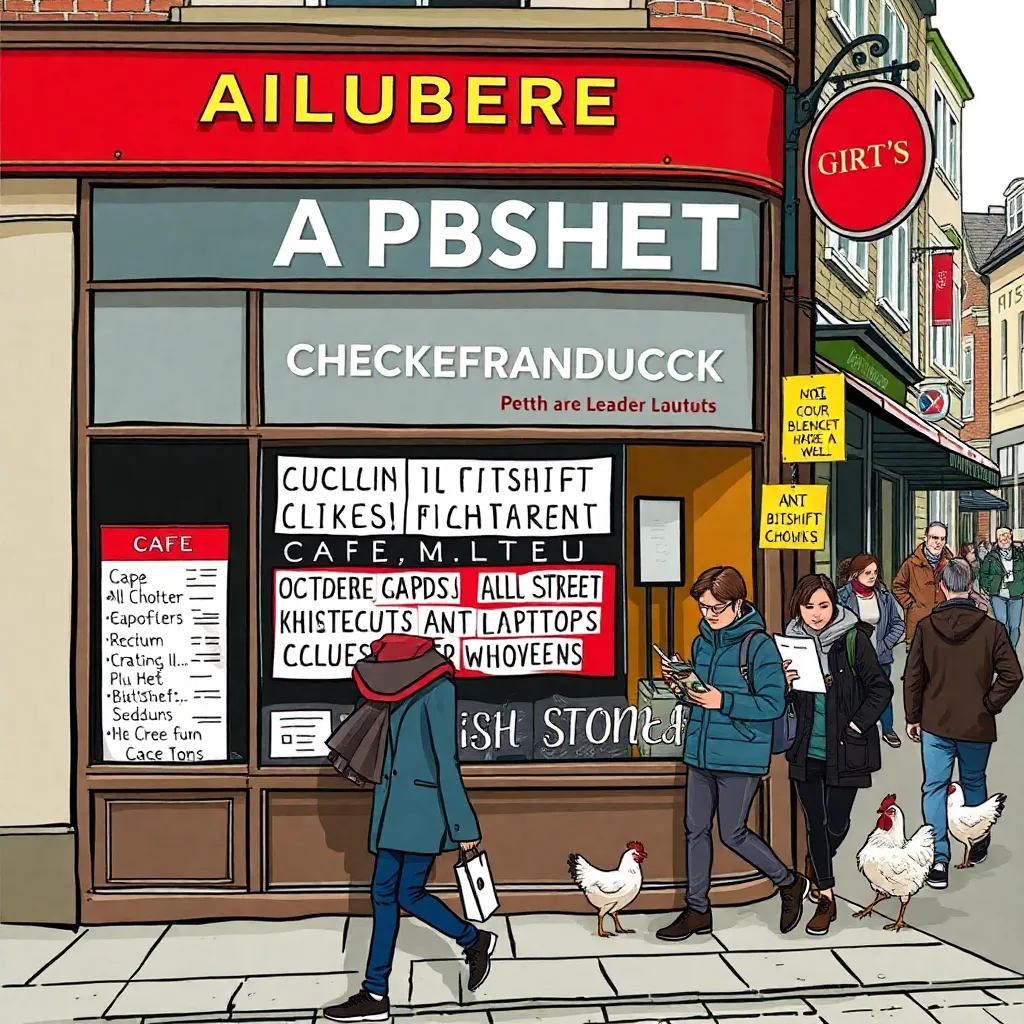
Meanwhile, businesses are already adapting. Several cafés have introduced crisis menus printed entirely in block capitals “until the vowels settle down,” while one electronics retailer now offers emergency anti-bitshift blankets for laptops. Demand has been strong, though consumer groups warn that many of the blankets are just tea towels with confidence.
Financial markets responded cautiously, with shares in keyboard manufacturers tumbling after rumours that the new layout may require a thirteenth row reserved for “adaptive letters.” Grain futures, by contrast, surged as investors sought refuge in what analysts called “hard agricultural certainty.”
Opposition parties have demanded an immediate suspension of the overhaul and the appointment of an independent inquiry chaired by “someone who can still type without weeping.” In parliament, debate was interrupted repeatedly by members discovering that their microphones had been remapped to issue accordion sounds whenever the letter T was mentioned.
As dusk fell, the chickens remained in formation, illuminated by hazard lights and a setting sun of unnecessary grandeur. Margaret Clucksworth, her silhouette crisp against the asphalt, gave no formal statement. Instead, she laid a single egg in the centre of the carriageway and walked away from it with the solemnity of a statesman unveiling a difficult budget.
The crowd fell silent. A child saluted. Somewhere in the distance, a desktop tower emitted a troubled beep and forgot its own name.
Government officials say they are monitoring the situation closely, though insiders admit the relevant dashboard now displays only soup recipes and one deeply accusatory pie chart. Negotiations are expected to resume this morning, assuming the negotiators can still locate the letter N.
Until then, the nation waits: one hand over the keyboard, one eye on the road, and both ears tuned to the low, revolutionary murmur of hens who have decided that if the alphabet is to be dismantled during a silicon malfunction, it will not happen quietly.