Declassified Files Confirm Illuminati Was Just Belgians Trying to Split Rent Fairly
The mystery that has haunted empires, unsettled uncles, and fueled at least 40 million low-resolution documentaries has finally been resolved by a stack of declassified documents, three municipal receipts, and a coffee-stained diagram labeled “Kitchen Rotation System Final FINAL v2.”
According to the files, the so-called Illuminati was not a shadow cabal steering world events from marble bunkers beneath Europe, but a loose association of Belgian flatmates attempting, with doomed optimism, to divide rent, utilities, and fridge space in a way everyone agreed was “basically fair if you think about it.”
The papers, released Tuesday after being misfiled for 212 years under “misc. triangles,” reveal that the organization’s famous all-seeing eye was originally a crude drawing of a landlord who “somehow notices everything except mold.” Their pyramid hierarchy appears to have been a chart explaining who had paid for toilet paper in May.

Researchers say the first major clue appeared in a handwritten meeting agenda from 1776 reading: “Agenda: 1. Guillaume keeps leaving one spoon in the sink and claiming this is not ‘doing dishes.’ 2. Clarify cheese ownership. 3. New method for calculating heating contribution because Luc opens windows while wearing scarf indoors.”
“For centuries, historians misinterpreted the coded language,” said one academic, carefully unfolding a parchment titled On Equitable Butter Allocation. “When they wrote about ‘the grand design,’ they meant where to put the bookshelf so nobody had to see the boiler. ‘The hidden hand’ referred to whoever was taking exact change from the jar. ‘A new world order’ referred to alphabetizing spices.”
The documents describe a secretive but deeply domestic society operating from a second-floor apartment above a bakery in Brussels, where members met by candlelight because nobody wanted to be the one who changed the hallway bulb. Initiation rites reportedly included reading the gas bill out loud, then saying, “That cannot possibly be right,” in three languages.
Much of the mythology appears to have grown from simple misunderstanding. Neighbors overheard phrases such as “We must control the flow” and assumed international finance, when records indicate the group was discussing shower scheduling. A memo titled On the Management of Global Resources turns out to be a stern note reminding everyone that “if you finish the coffee, you write it down.”
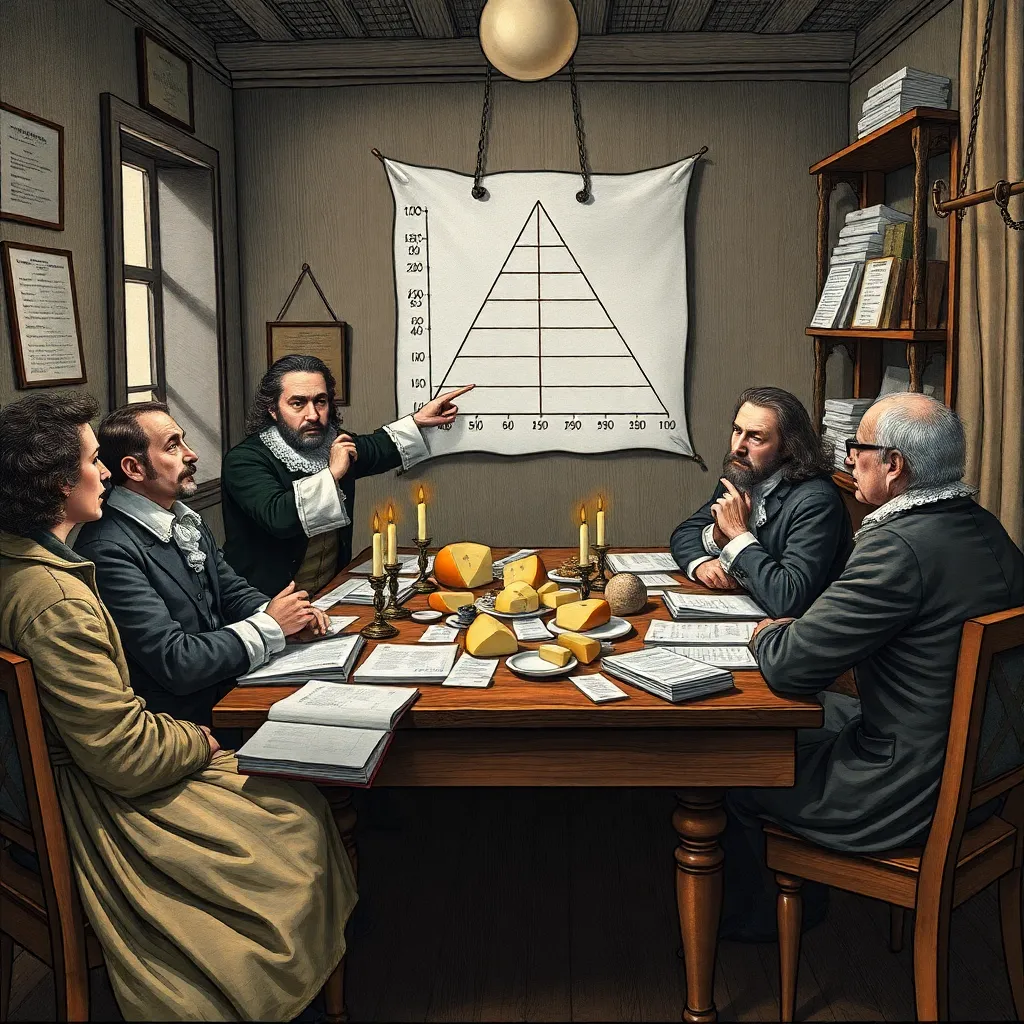
The most explosive file details the society’s internal factions. One, known as the Order of the Eternal Spreadsheet, believed rent should be divided by room size, window access, and “overall vibes.” Another, the Circle of Shared Burdens, favored equal distribution regardless of room dimensions on the grounds that “friendship is priceless but parquet-facing bedrooms are not.”
A third splinter group, described ominously as “the Radical Centrists,” proposed rotating rooms every six months until all members had “known both privilege and radiator noises.” Historians believe this proposal nearly collapsed the entire enterprise after one member refused to surrender what sources called “the good shelf.”
Experts now suspect many global symbols were innocent apartment artifacts exaggerated by rumor. The famous secret hand signs? Requests for someone to pass the mustard. Robed gatherings? Laundry day. The whispered references to “the inner circle”? Chairs in the kitchen were limited.
One heavily redacted dossier includes what may be the original source of the group’s fearsome reputation: a disciplinary action against a member identified only as “P.” The offense: labeling milk “communal” and then becoming “strangely private about it after 10 p.m.” The recommended punishment was severe by any era’s standards: hosting the next budget meeting and receiving all questions about internet speed.
Government officials admitted the truth had been hidden for generations because “the paperwork was unbelievably boring” and because previous attempts to explain the situation accidentally made it sound more sinister. “Every time we said ‘They were coordinating resource distribution through invisible structures,’ people heard ‘global domination,’” said one archivist. “We meant shelves. It was shelves.”

The release has sent shockwaves through conspiracy communities, many of whom are struggling to adapt to the possibility that history’s greatest enigma was fundamentally about whether couples should pay more for occupying “an emotionally larger section of the sofa.” Several online forums have already rejected the documents as planted misinformation by “Big Tenant.”
Others, however, have embraced the evidence. “Honestly, it explains everything,” said one lifelong theorist, quietly deleting 900 posts about lunar banking rituals. “The secrecy. The symbols. The endless meetings. The impossible sense that nobody was truly happy with the arrangement. That’s not world government. That’s a shared apartment.”
Belgium’s government responded with a brief statement acknowledging the historical findings and asking the public to “stop mailing ornate compasses to city hall.” In Brussels, a commemorative plaque is reportedly being considered for the original apartment building, though negotiations have stalled over who exactly should pay for it.
Meanwhile, scholars continue poring over the archive for additional revelations. Among the untranslated materials are Minutes of the Supreme Council of Fridge Geometry, Treatise on Passive-Aggressive Notes as Instruments of Social Stability, and an encrypted ledger believed to contain the formula for calculating what one member called “the fair and ancient tax upon guests who say they will only stay a week.”
The final page in the collection may be the most moving. Beneath columns of figures, arrows, and increasingly agitated annotations about onions, the anonymous author offers a closing statement that now reads less like the creed of an occult order and more like the sigh of a person who has asked too many adults to use a coaster.
“We sought not power,” it says, “but a system. And if mankind was not prepared for itemized detergent reimbursement, that is mankind’s failing, not ours.”