Global Outcry as Prince Albert Remains Trapped in Tobacco Can for 40th Anniversary
Diplomatic relations entered a period of visible wheezing this week as crowds gathered in capitals across the world to mark the 40th anniversary of Prince Albert remaining, against all expectations and several basic engineering assumptions, trapped inside a tobacco can.
The anniversary was observed with candlelight vigils, commemorative coughing, and a minute of respectful rattling in which citizens shook small metal tins beside their ears and whispered, “Are you still in there, sir?” In London, the bells rang solemnly. In Paris, a panel of philosophers declared the can “a prison, a paradox, and possibly a promotional offer gone too far.” In Geneva, officials attempted to negotiate with the lid.
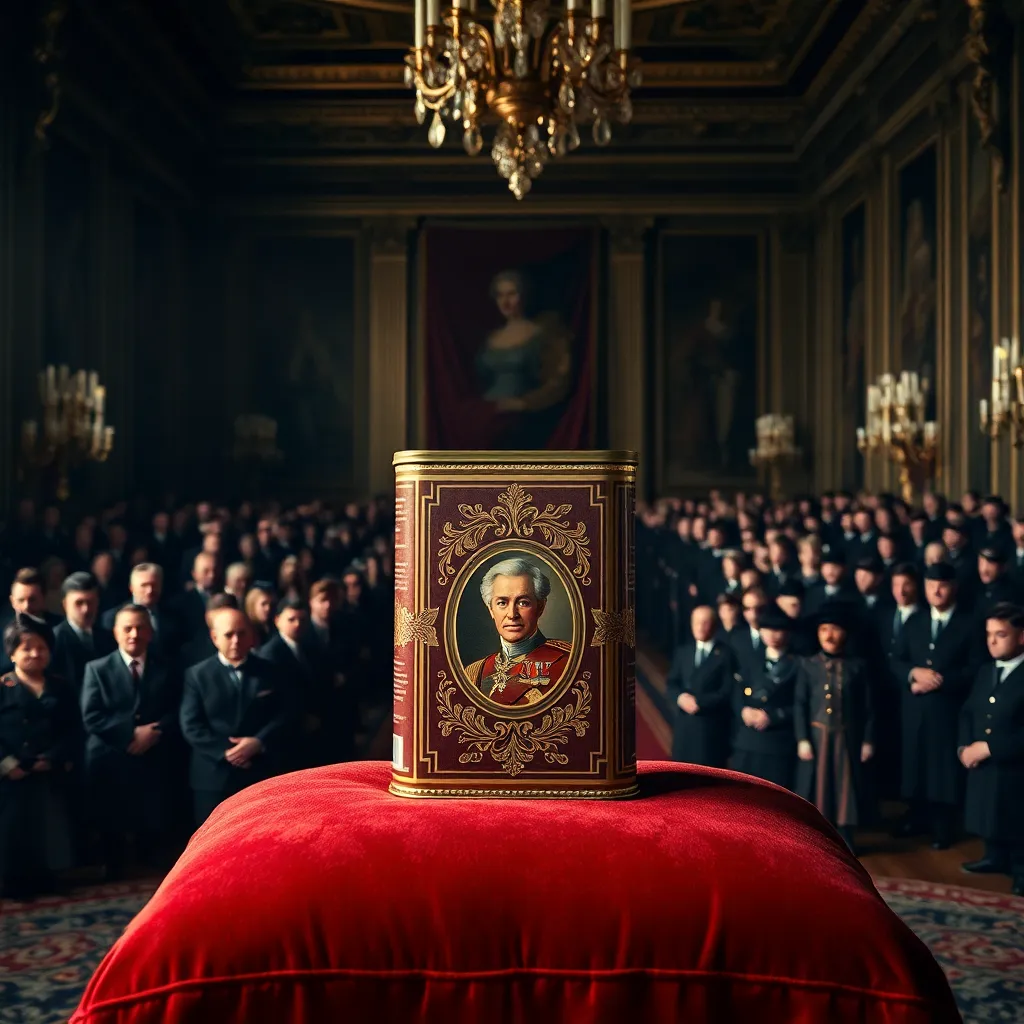
The crisis began four decades ago, when an optimistic public first asked the now-historic question: Is Prince Albert in the can? To the horror of everyone involved, the answer was yes. Since then, generations have grown up under the long metallic shadow of uncertainty, taught from childhood to respect both monarchy and proper ventilation.
At a press conference outside Buckingham Palace, a spokesperson addressed the nation from behind a podium bearing the royal crest and several warning labels.
“His condition is believed to be stable,” the spokesperson said. “He remains compact, aromatic, and dignified under the circumstances. We continue to explore all options, including rotational loosening, strategic tapping, and speaking very firmly to the container.”
International concern has intensified in recent years as conservationists warn that prolonged princely canning may have broader environmental consequences. “If one high-profile aristocrat can become permanently lodged in a cylindrical tobacco vessel,” said Professor Lenora Fitch of the Institute for Catastrophic Packaging, “it raises alarming questions about the vulnerability of dukes, barons, and especially those viscounts who travel without supervision.”
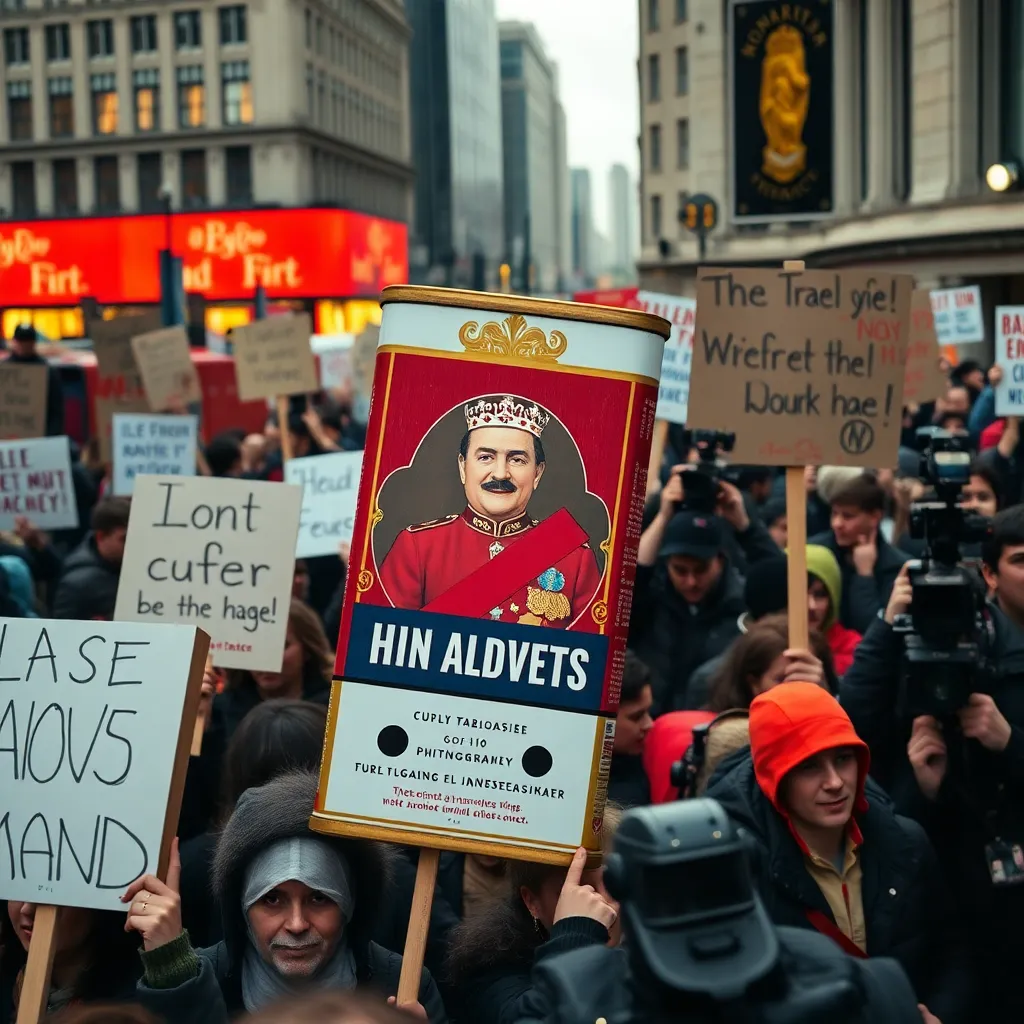
In New York, protesters gathered outside the headquarters of a major packaging firm carrying signs reading FREE THE DUKE, NO NOBLE LEFT BEHIND, and the more policy-oriented RETHINK SEALING TECHNOLOGIES. Organizers reported a turnout of nearly 12,000 people, though some admitted several attendees had simply mistaken the event for a street fair dedicated to antique tins.
The can itself has become one of the most scrutinized objects on Earth. Analysts have studied archival photographs, consulted retired locksmiths, and brought in a team of pastry chefs after one minister misheard the phrase “crack the tin” and approved emergency funding. So far, none of the attempts have yielded a breakthrough, though one éclair shaped like constitutional reform has been praised as “encouraging.”
Ordinary citizens have also taken the matter personally. “I was a boy when I first heard he was in there,” said Harold Pimm, 67, clutching a commemorative opener issued for the 25th anniversary. “I thought surely by now they’d have got him out. We’ve put satellites in orbit. We’ve invented smart kettles. And yet there he remains, in a can, like some sort of deeply official sardine.”
Social media has only intensified the emotional temperature. The hashtag #LetAlbertBreathe trended globally after a blurry palace image appeared to show the can shifting slightly during a state banquet. Amateur experts immediately split into factions: those who believed this was evidence of an imminent escape, and those who argued the movement was caused by “normal royal settling.”
Not all have handled the anniversary with grace. A black-market trade in counterfeit “liberation tins” has surged online, with scammers promising that buyers will receive “one authentic fragment of historical lid” and “exclusive correspondence from inside.” Authorities urged caution after one customer in Surrey paid £800 for what turned out to be a biscuit tin containing only pipe-cleaners and a short note reading, Nearly had him.
Inside academic circles, debate remains fierce over whether Prince Albert is literally trapped, symbolically trapped, or participating in a prolonged constitutional installation piece. A symposium at Oxford descended into shouting after one historian argued that the can is not merely a container but “a sovereign condition.” The remark was met with boos, then applause, then a brief but meaningful silence as everyone considered whether they too were trapped in systems of their own manufacture.

World leaders have now weighed in. The Prime Minister called the anniversary “a sobering reminder that no nation can truly flourish while a member of the upper crust remains lodged in processed leaf storage.” The President of France offered assistance, saying French engineers have extensive experience with difficult lids, impossible jars, and situations that become more elegant the longer they remain unresolved. Canada lowered flags to half-mast, then raised them again after officials clarified that Prince Albert is not technically missing so much as “densely located.”
Royal watchers say the family remains hopeful. According to palace insiders, a small tea service is laid daily near the can “for morale,” and musicians sometimes perform chamber pieces in adjacent rooms in case the prince finds them comforting through the metal. One footman reportedly swore he heard faint knocking during an oboe recital, though skeptics noted this coincided with the arrival of the catering trolley.
As the anniversary ceremonies concluded, thousands joined in a final vigil beneath gray evening skies. Children placed handwritten messages beside replica tins. Veterans saluted. Somewhere, a lone harmonica played with the seriousness of a budget debate. Then, just as the crowd fell silent, witnesses claimed a voice emerged from the can itself.
Accounts vary, but several insist it said only this: “I’m perfectly all right, but do stop asking.”
The statement has done little to calm the global mood. If anything, it has deepened the mystery. Was it the prince? Was it trapped air? Was it, as one tabloid suggested, “the sound of monarchy entering its artisanal phase”?
For now, the can remains sealed, the world remains watchful, and Prince Albert, in defiance of time, common sense, and at least three emergency commissions, remains where history first found him: in the can.