Groo the Wanderer Declares War on Breakfast: Epic Saga of Misadventures and Musli Leaves Kingdoms Crumbed
By our staff correspondent, filing from the smouldering ruins of a once-proud granary
The great chroniclers of our age have long argued over what truly defines “heroism.” Is it courage? Honour? A willingness to stare down evil with a steady blade and a steady gaze?
Or is it the ability to march into an unfamiliar village, misunderstand the word “musli,” and accidentally trigger a continental crisis involving fermented oats, insulted farmers, and a militia of extremely patient breakfast enthusiasts?
According to witnesses, the latter.
Groo the Wanderer—renowned swordsman, accidental arsonist, and the only man ever to be asked to leave a monastery during silent prayer—has once again tripped across the fragile latticework of civilisation, leaving behind a trail of dented helmets, confused treaties, and a surprisingly cohesive new religion centred on dried fruit.
The Incident: “I Demand Your Finest War Rations”
Trouble began, as it so often does, when Groo arrived hungry.
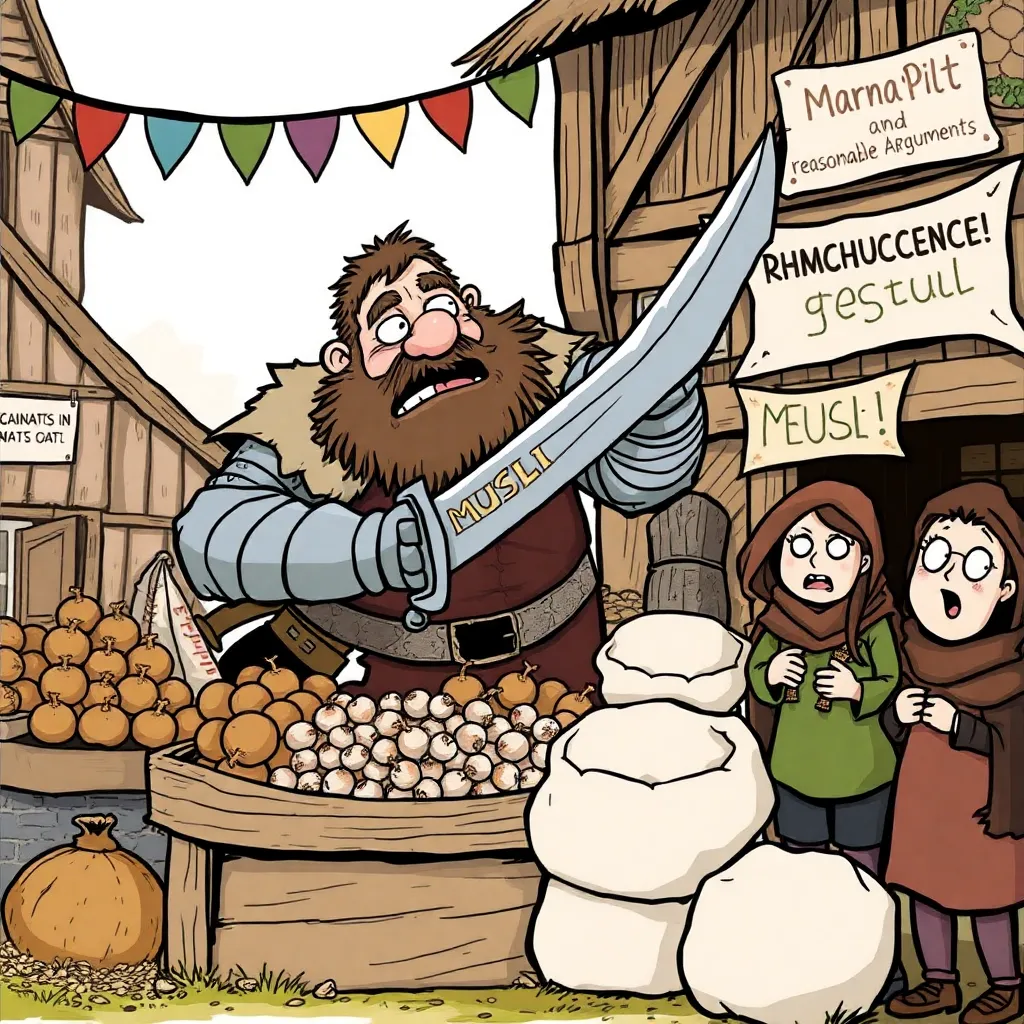
The sleepy border town of Quenched Hollow was preparing for its annual Harvest-and-Reasonable-Arguments Festival, a gentle event where locals traditionally celebrate abundance by politely disagreeing about which grain is “most humble.”
Groo, fresh from what he described as “a long journey across the plains” (and the locals described as “walking in a circle behind the inn for four days”), approached the marketplace and demanded “musli,” loudly, repeatedly, and with the kind of intensity normally reserved for interrogations.
“I thought he meant a weapon,” said Marna Pilt, a stallholder who sells artisanal turnips and has now been promoted to Acting Mayor due to the previous mayor fleeing into a barrel. “He kept shouting it like it was a battle cry. MUSLI! Then he pointed at my dried apples like they were traitors.”
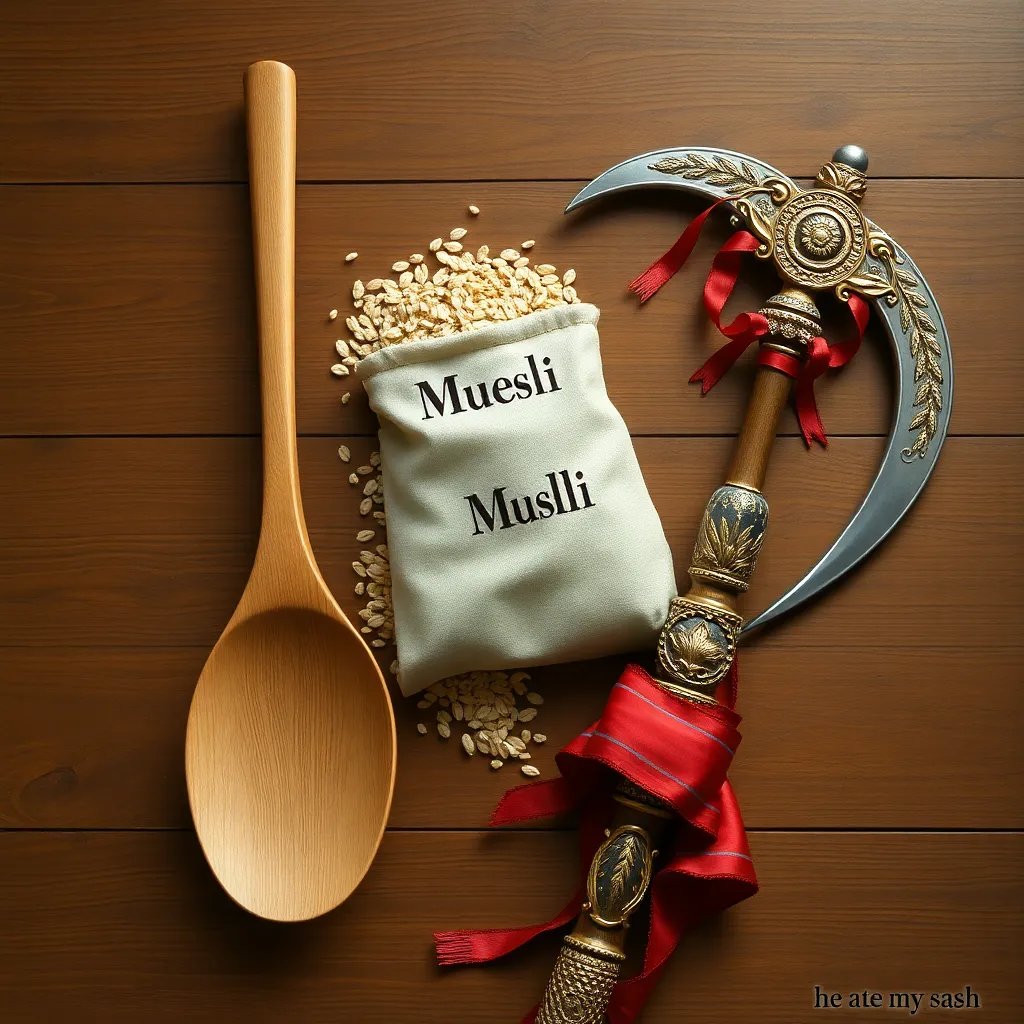
Within minutes, Groo had purchased (without haggling, an alarming sign in any society) a sack of muesli, a spoon the size of a canoe paddle, and, due to a communication error involving gestures, a ceremonial scythe belonging to the town’s Harvest Queen.
“He said it looked ‘heroic,’” she told reporters, still visibly trembling. “I told him it symbolised the cycle of life and renewal. He said, ‘Good. I will use it to renew the faces of my enemies.’ Then he ate my sash.”
A Simple Breakfast Spirals Into International Conflict
Matters escalated when Groo attempted to “improve” the musli by adding what he called “war milk.”
War milk, it turns out, is not a thing.
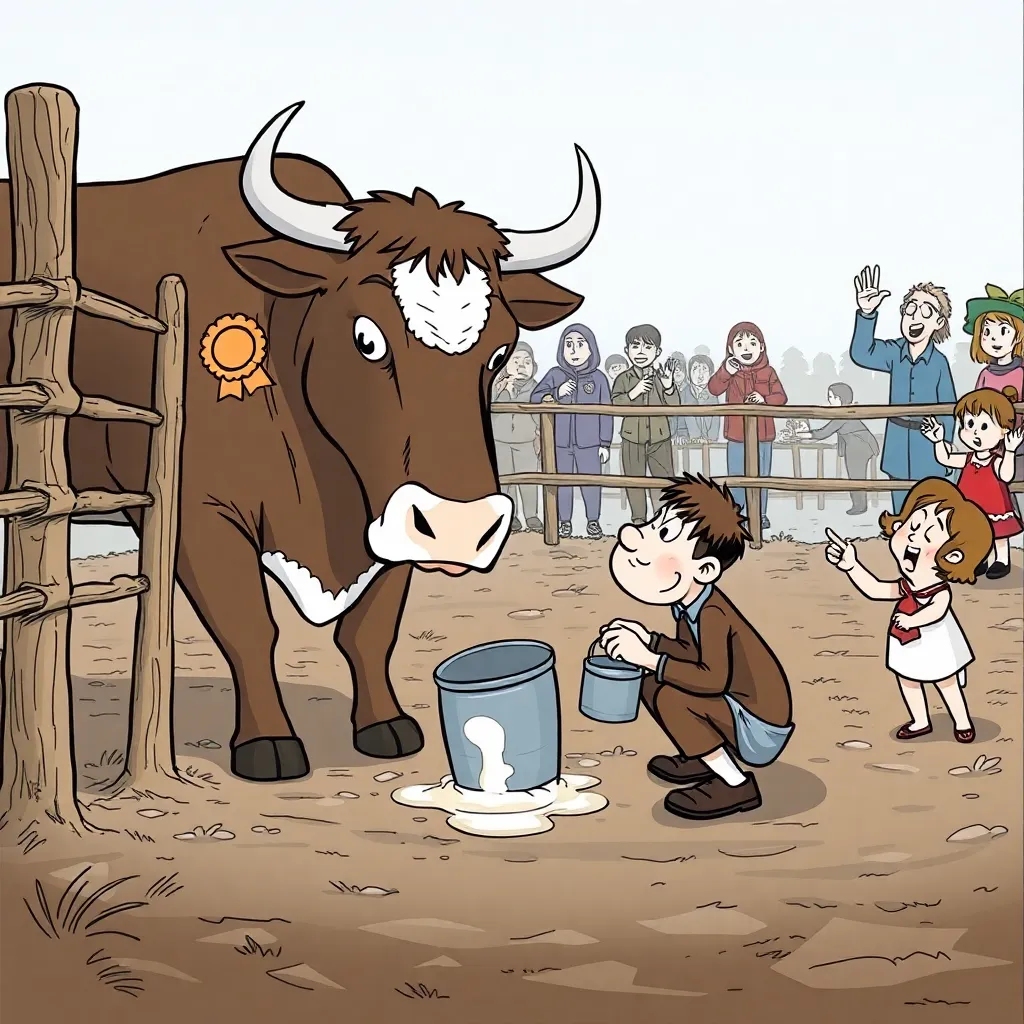
Groo’s understanding of dairy production appears to involve milking whichever animal looks most confident. This brought him, with grim inevitability, to the town’s prize bull, a creature bred for festivals, prestige, and not being handled by wandering swordsmen with the attention span of a mayfly.
What happened next is subject to some dispute, but the broad consensus is as follows:
Groo attempted to milk the bull.
The bull objected.
Groo took this as a challenge to his honour.
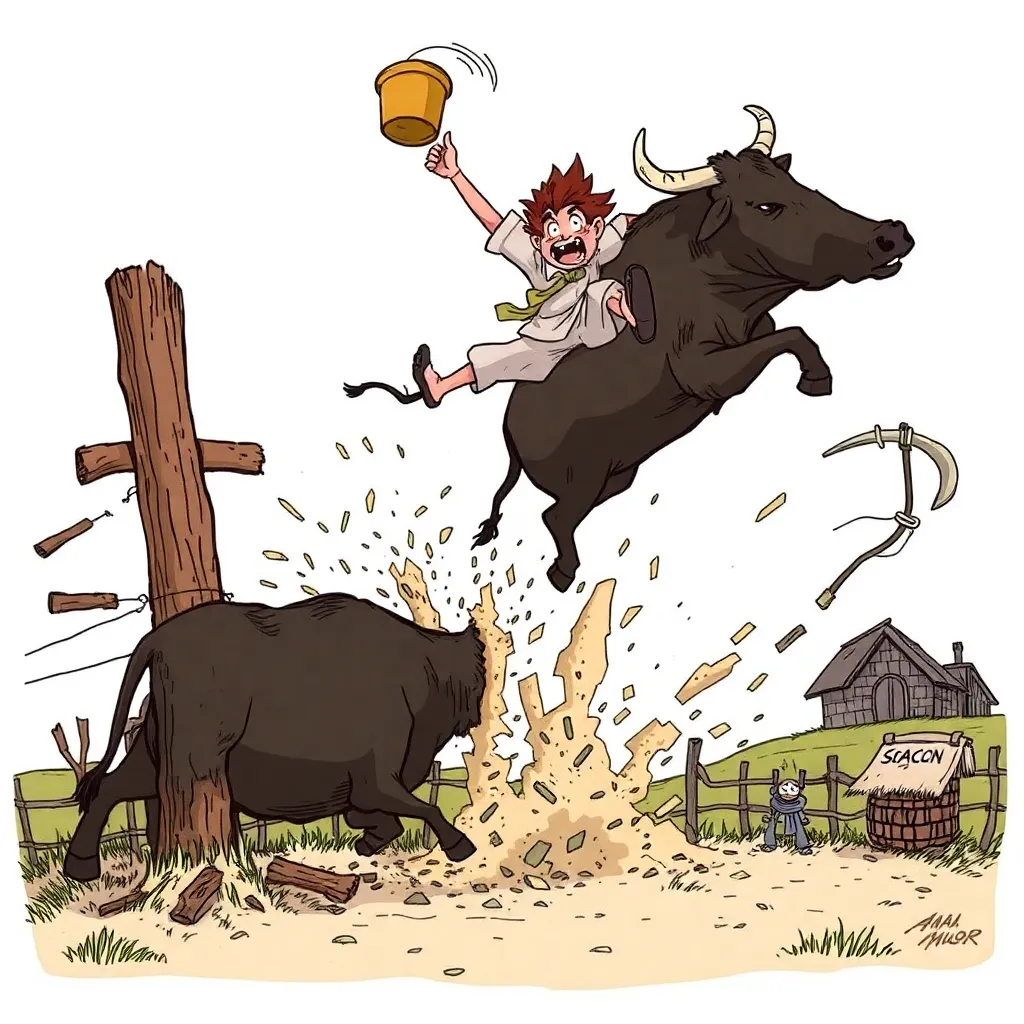
The bull took this as an opportunity to introduce Groo to a fence post.
The fence post took this as its moment to become part of legend.
In the chaos, the ceremonial scythe was flung—possibly by Groo, possibly by fate—into the town’s granary, where it struck a support beam. The granary, already weakened by years of storing “experimental oats,” collapsed in a dramatic cascade of grain.
With a rumble that witnesses described as “the sound of an empire quietly giving up,” the entire winter supply of oats poured into the town square, burying three merchants, a travelling poet, and an estimated twelve thousand raisins.
The poet survived, but only to write about it.
The Great Oat Slide of Quenched Hollow
The oat spill formed what engineers are now calling “a catastrophic breakfast dune” and what children immediately recognised as “the best thing that has ever happened.”
For two hours, the town’s youth sledded down the oat mound on shields, doors, and one surprisingly resilient goat, until Groo—ever eager to lead—attempted to “conquer the peak.”
This involved climbing the oat pile, raising the scythe, and declaring himself “Lord of Musli, Keeper of the Crunch.”
Unfortunately, the oat pile was unstable, and Groo’s declaration triggered what experts refer to as “an avalanche, but sadder.”
The resulting oat slide surged into the river, which promptly clogged, overflowed, and diverted itself through the only road connecting Quenched Hollow to the neighbouring duchy of Drelm.
Drelm, a nation famous for two things—its rigid border discipline and its complete inability to understand humour—interpreted the sudden arrival of porridge water as an act of aggression.
Within a day, the Duke of Drelm issued an official statement condemning Quenched Hollow for “weaponising breakfast.”
Diplomats Attempt Peace; Groo Attempts “More Crunch”
The crisis might have ended there, with an embarrassed letter and a mutually agreed-upon apology involving a ceremonial spoon. But Groo, sensing drama, wandered directly into the diplomatic proceedings, as if drawn by the magnetic pull of important conversations he does not understand.
At the hastily arranged summit, Groo reportedly offered to resolve tensions by suggesting everyone “share musli as brothers,” then attempted to demonstrate by pouring a bowl directly onto the Duke’s head.
The Duke responded by ordering his guards to arrest Groo.
Groo responded by asking if the guards had any honey.
What followed was less a battle and more a complicated series of accidents. Groo slipped on spilled oats, collided with a mounted guard, and was propelled—scythe first—into the summit tent, which collapsed on the assembled negotiators.
“It looked intentional,” said one diplomat, emerging from the wreckage with a tent peg in his sleeve and dignity nowhere to be found. “But then he apologised to the tent.”
Groo, for his part, later explained his actions to reporters with the solemn clarity of a man who has never had to face consequences.
“I am a peacemaker,” he said. “And also hungry.”
Academic Community Splits Over “The Musli Doctrine”
As news spread, universities rushed to offer analysis, funding proposals, and smugness. Scholars are now divided over whether Groo’s musli incident represents:
a deliberate critique of border politics,
an allegory for resource distribution,
or simply a man who should not be allowed near food.
Professor Halden Troke, Chair of Semiotic Violence at the Royal Institute of Overthinking, insists the event carries deep symbolic weight.
“Oats,” he said, adjusting spectacles that were purely decorative, “are an ancient signifier of civilisation. Groo’s disruption of the granary is a destabilisation of social order. The bull represents masculinity. The raisins represent—”
He paused.
“The raisins represent the tragedy of the overlooked.”
Local farmer Wen Doss offered an alternative interpretation.
“He’s thick,” Doss said. “That’s the whole thing. He’s just thick.”
Witnesses Report Groo’s “Heroic” Aftermath Efforts
In the wake of the disaster, Groo attempted to help, in the way a storm might attempt to help by blowing the roof off a burning building.
He offered to “rebuild the granary” by stacking leftover oats into a tower, which immediately attracted birds, which immediately attracted wolves, which immediately attracted Groo’s sense of adventure.
He then tried to “secure the border” by digging a trench, accidentally re-routing the river again, this time into Drelm’s wine cellar, prompting a second diplomatic incident known now as The Merlot Flood.
When asked whether he felt responsible for any of this, Groo displayed a familiar combination of confidence and total misunderstanding of causality.
“I did not start the river,” he said. “The river has always been there.”
When reminded that he had, in fact, moved the river twice, he frowned, as if hearing a riddle.
“The river is free,” he said at last. “Like me.”
The Breakfast Militia Mobilises
As tensions rose, Quenched Hollow’s citizens formed a defensive force, the Oat Guard, composed primarily of farmers, bakers, and one particularly stern nun armed with a rolling pin. Their mission: protect remaining stores, prevent further incidents, and keep Groo away from anything that can be poured.
They have already drafted strict regulations, including:
No swords within ten paces of grain.
All travellers must declare if they have ever yelled the word “musli” in public.
Groo the Wanderer is not permitted to point at livestock.
When informed of these rules, Groo nodded thoughtfully, then asked if he could eat the regulations.
He was told no.
He ate them anyway.
Economic Fallout: Raisins Surge, Milk Plummets
Markets have reacted swiftly. Oats have become scarce across the region, causing panic buying and a brief, ugly black market in “grain-like substances.”
Meanwhile, raisins—once the object of universal indifference—have soared in value due to their sudden association with international chaos. Some investors are reportedly moving assets into dried fruit, believing it to be “the only stable currency left.”
Milk, however, has suffered. The bull incident has sparked rumours that dairy is “inherently combative,” and several towns have begun replacing milk with “calming broth” in breakfast recipes.
One entrepreneur has begun selling “Groo-Free Musli,” promising that it has not been touched, blessed, cursed, or misinterpreted by any wandering swordsman.
Early reviews are positive.
“It tastes normal,” said one customer, sounding astonished.
Where Is Groo Now?
After the summit collapse, Groo was last seen marching confidently toward the western hills, carrying the ceremonial scythe, a sack of musli, and what appears to be the Duke of Drelm’s official seal, which Groo claims he won “in a contest of wills.”
The Duke disputes that a “contest of wills” occurred, noting that Groo took it while everyone was trapped under canvas.
Groo’s next destination is unknown, but his parting words to Quenched Hollow were recorded by multiple witnesses, largely because they were shouted.
“I will go find the legendary Yogurt of Destiny!” he declared. “And maybe some nuts!”
Authorities across the region have issued alerts advising communities to secure their granaries, lock their dairy animals, and hide anything that could be interpreted as a ceremonial object.
A Cautionary Tale, Served Cold
In the end, Quenched Hollow will rebuild. Drelm will eventually forgive, if only because it cannot sustain this level of outrage without exhausting its entire national supply of stern letters. The river will settle into a path that does not pass through wine cellars. The children will stop trying to sled down breakfast.
But Groo will remain what he has always been: a wandering epic in human form, a man who turns the ordinary into legend through sheer refusal to understand it.
As one exhausted villager put it, staring at the ruined granary and the lingering scent of damp oats:
“Next year, we’re doing a festival about potatoes. They’re harder to weaponise.”
He paused.
“Probably.”