Indiana Jones and the Furious Monorails: A Geriatric Adventure
Archaeologists confirmed yesterday that Dr. Henry “Indiana” Jones Jr. has returned to the field, although “the field” now appears to be a climate-controlled transit hub with several benches, a smoothie kiosk, and a deeply threatening escalator he refuses to trust on ideological grounds.
Witnesses at the Tri-County Heritage Transit Expo say the veteran adventurer arrived at dawn in a tweed jacket, sensible orthopedic boots, and a hat with a note tucked into the brim reading, “If found wandering, point me toward destiny or the nearest restroom.” He was reportedly searching for the Lost Fare Card of Antioch, an ancient pass said to grant unlimited access to every municipal monorail built between 1974 and one regrettable ribbon-cutting in 1991.
Museum officials had initially dismissed the legend as impossible. “There’s no evidence the Fare Card ever existed,” said one curator, moments before being flattened emotionally by a 400-page ledger proving that a secret order of urban planners had hidden it inside a decorative station clock in 1986. “We are dealing,” the curator added, while removing his glasses and staring into the middle distance, “with a man who can smell laminated relics through two walls.”
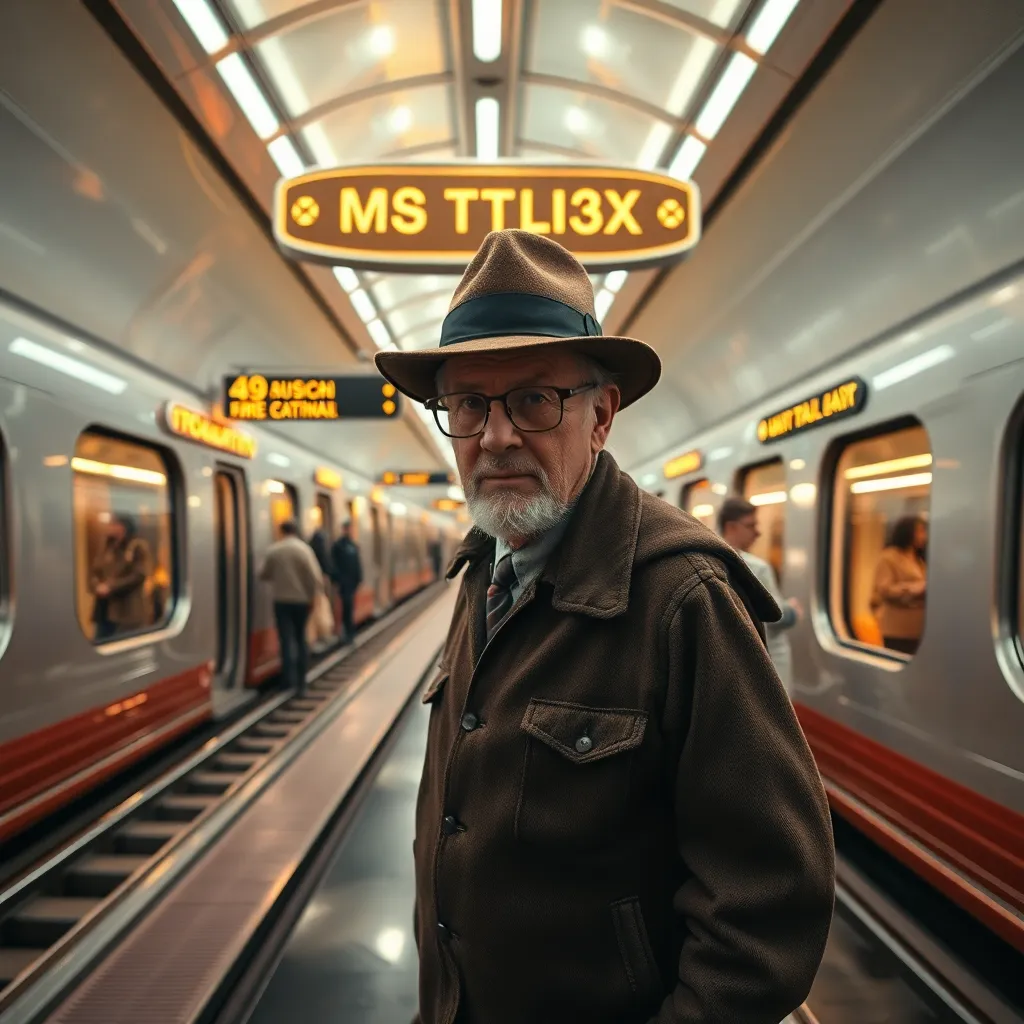
The chase began shortly after 9 a.m., when Indiana Jones realized he was not the only one after the artifact. His longtime rivals, a consortium of highly aggressive retirees known only as the Silver Vultures, had also entered the terminal armed with telescoping grabbers, sensible rain capes, and a complete willingness to cut in line if civilization depended on it.
Security footage shows Jones sprinting at an estimated speed of “alarming for his age” down Platform B, pursued by three enemies and one volunteer cardiologist begging everyone involved to sit down for a moment. Instead, Jones vaulted over a velvet rope, landed cleanly, then took three full minutes to recover while pointing dramatically at a ticket machine and whispering, “It belongs in a museum.”
Transit authorities say the machine was unharmed.
By noon, the pursuit had spread across six elevated rail loops, two visitor centers, and one botanical garden that was in no way relevant but offered excellent shade. Riders aboard the Blue Comet line described scenes of escalating chaos as Jones leapt from car to car, pausing between jumps to apply topical cream to his left knee.
“He moved like a panther who reads prescription labels,” said one passenger, still clutching a commemorative monorail spoon. “At one point he cracked a bullwhip across a malfunctioning turnstile, swung through a closing door, and then asked if anyone had a peppermint.”
Experts have praised the technical brilliance of his operation. Rather than relying solely on daring, Jones reportedly used a sophisticated mix of intuition, historical knowledge, and muttered complaints about modern seating. He identified the hidden map to the Fare Card after noticing that a station mural of cheerful commuters contained Phoenician route symbols, Byzantine transfer markings, and what several linguists have classified as “an unmistakable warning to avoid the food court chili.”
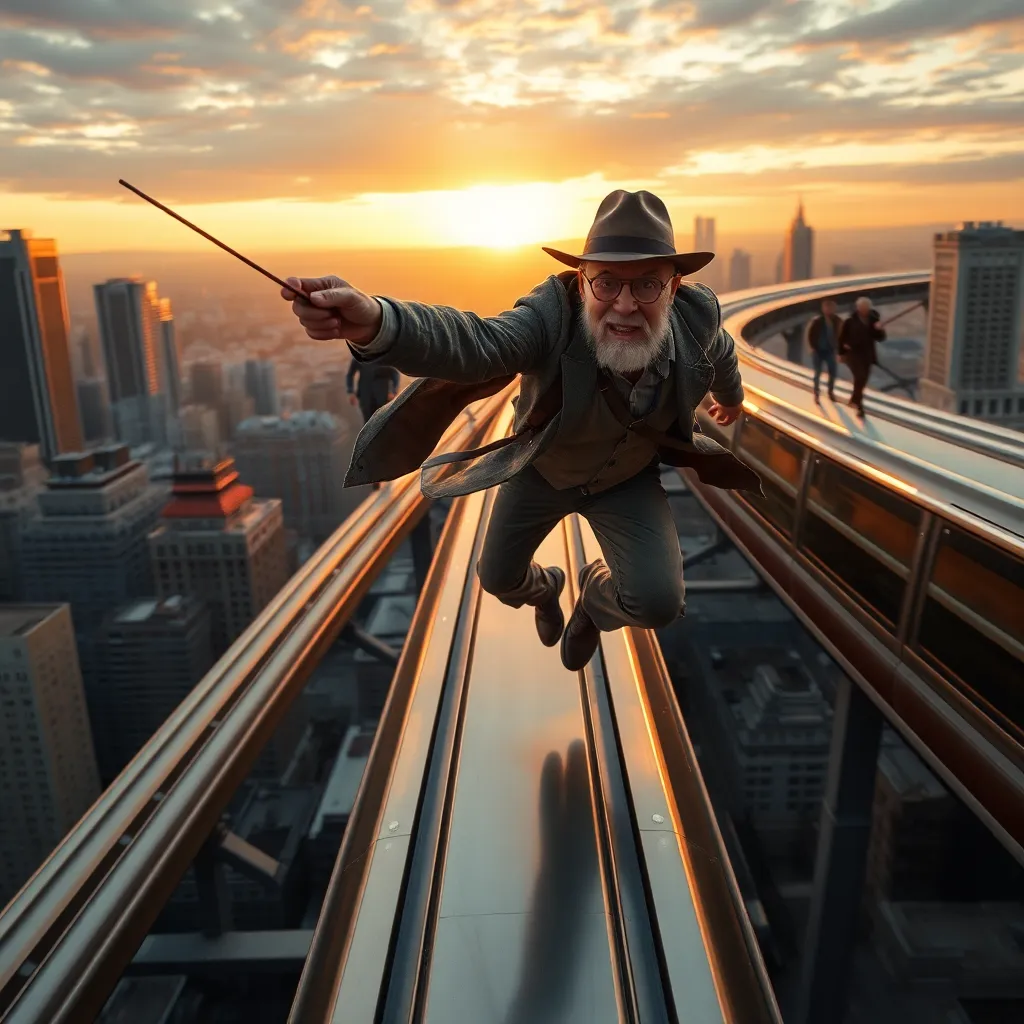
The map led all parties to the legendary Sub-Basement of Transfers, a forbidden underground chamber beneath the region’s first monorail station, accessible only by solving a sequence of puzzles designed by transportation commissioners with too much time and a dangerous affection for Roman numerals.
There, amid cobwebbed route diagrams and ceremonial conductor caps, Jones encountered the chamber’s final defense: a colossal stone mobility scooter carved with the faces of forgotten mayors. According to surviving notes, the scooter activated when Jones stepped on a mosaic depicting “peak fare hours” and rolled toward him with the implacable fury of local government.
Witnesses say he escaped only by replacing the missing gemstone in the Eye of Commuteria, a jewel later identified as a decorative brooch from his own jacket. This caused the entire chamber to shudder, ring a polite chime, and reveal the Fare Card atop a pedestal labeled VALID UNTIL MYSTERY.
For one glorious second, Indiana Jones held the artifact aloft. Onlookers say a shaft of light pierced the darkness, illuminating the sacred laminate in all its bureaucratic majesty. Then, as tradition demands, someone immediately tried to grab it.
What followed has already been called one of the most ferocious scuffles in transport archaeology. Jones and the Silver Vultures wrestled atop the platform while ancient departure boards flickered cryptic warnings such as TRACK DELAYED BY PROPHECY and STAND CLEAR OF THE CLOSING FATE. One rival was defeated by stepping confidently into a decorative reflecting pool she had mistaken for polished granite. Another was distracted permanently by a half-price scone voucher.
Jones himself nearly lost the card when the chamber began collapsing under the weight of its own symbolism. Broken signage rained down. Brass railings buckled. Somewhere in the distance, an unseen announcer calmly informed everyone that service to the afterlife had been temporarily suspended due to track conditions.

In the end, he did what few thought possible: he relinquished the Fare Card rather than let it fall into private hands. Cornered at the terminus by the Silver Vultures and one extremely judgmental pigeon, Jones inserted the relic into the original monorail console, activating the long-dormant Ceremonial Express, a train said to run only when civic paperwork and destiny are in complete alignment.
The train arrived precisely on schedule, which experts agree is the least believable part of the story.
As the ancient cars hummed to life, the Fare Card fused into the controls and triggered the station’s final secret: every monorail in the region synchronized into a perfect figure-eight visible from orbit and mildly upsetting to traffic engineers. The Silver Vultures, unable to comprehend a transit system operating flawlessly, surrendered on the spot.
Jones boarded the Ceremonial Express alone, except for a thermos, a leather satchel, and a packet of throat lozenges. He was last seen standing at the rear platform, wind in his face, hat slightly askew, glaring at eternity like it had parked in a loading zone.
Officials later found him twenty minutes away at a retirement community ribbon-cutting, where he claimed he had merely taken “a tactical detour.” He has since refused all interviews, though neighbors report hearing him shout “Not the knees!” during his afternoon nap.
Scholars remain divided over what the adventure means. Some argue it marks the final chapter in the life of a legendary explorer. Others insist it is merely the beginning of a new era in which relic-hunting, public transit, and calcium supplements are no longer considered separate disciplines.
For his part, Jones appears uninterested in legacy. When asked whether he would undertake one last mission, he reportedly stared at the horizon, adjusted his bifocals, and replied, “Depends. Is there seating?”