Bronze Greg Declared “Too Supportive” After Giving Unsolicited Life Coaching to Entire Town
Residents of Lower Wibbleford gathered at dawn yesterday to witness a scene many described as “deeply civic” and “frankly exhausting” as the town’s beloved hero statue, The Courage of Gregory Finch, began dispensing unsolicited advice to anyone who passed within a 40-foot radius.
For 87 years, the bronze figure had stood in Market Square with one arm raised toward the future and the other resting on what historians now agree was “probably a very symbolic cabbage.” Schoolchildren climbed its plinth, pigeons held their annual summit upon its shoulders, and wedding photographers used it as a backdrop for shots meant to suggest permanence, valor, and municipal parking validation.
That all changed at 6:14 a.m., when local baker Nina Crumb approached the square carrying a tray of cardamom buns and heard, in a resonant metallic baritone, the words: “You need to stop apologizing before you speak. Also, your sourdough starter fears abandonment.”
Crumb initially assumed this was the sort of thought one has before breakfast and attempted to ignore it. But the statue continued.
“Your boundaries are decorative,” it reportedly said. “You call that self-care? That’s just sitting on the floor near a candle.”
By 8 a.m., a crowd had formed, many of them reluctantly improved.
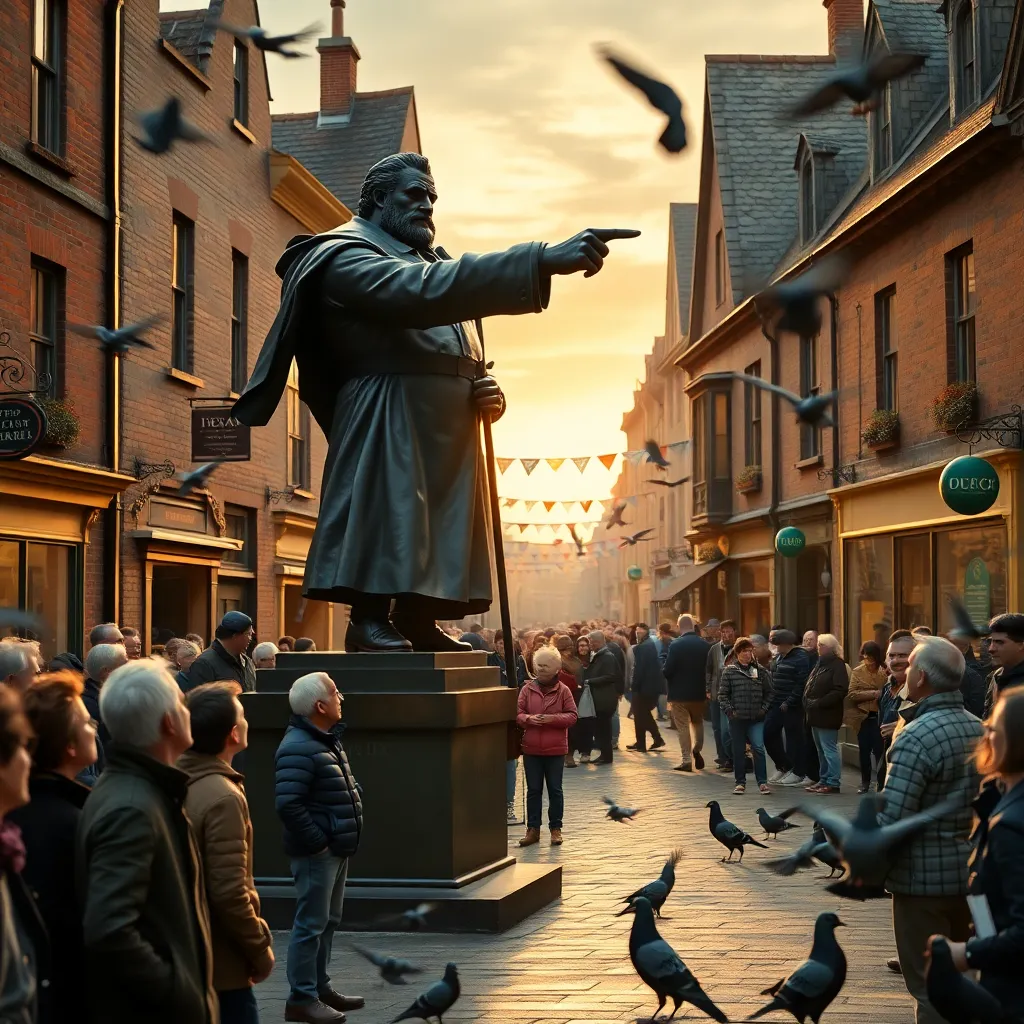
Council records show no prior indication that the statue would awaken and begin auditing the emotional posture of passersby. Commissioned in 1939 to honor local cooper Gregory Finch, who once rolled three flaming barrels away from an orphanage and into a canal “with unusual commitment,” the monument had previously been notable mainly for its greenish patina and a long-running dispute over whether the face looked noble or just mildly disappointed.
Now, however, it has become impossible to buy onions or visit the post office without being confronted by a seven-foot bronze man asking if your “busyness is perhaps a performance.”
“It looked directly at me,” said Martin Vale, 52, who had only intended to nip across the square for stamps. “And it said, ‘You keep saying “it is what it is,” Martin, but have you considered that this phrase is the duvet cover of surrender?’ Then it asked why I still own a fondue set from a marriage that ended in 2009. I didn’t even know statues could know about that.”
Others reported similarly invasive encounters. Teenagers loitering near the fountain were told they were “confusing irony with a personality.” A man eating a handheld pie was informed he had “made convenience into a creed.” One labradoodle was advised to “be less available.”
Shopkeepers have struggled to maintain ordinary business amid the torrent of copper-alloy guidance.
“It’s bad for foot traffic,” said florist June Petal, while rearranging a display of hydrangeas that the statue had described as “visually needy.” “People are taking the long way round through the alley by the bins. On the other hand, my husband finally booked a dentist appointment after the statue shouted, ‘Mouths are not self-healing caves, Derek.’ So I can’t say it’s all bad.”
The advice itself appears tailored, relentless, and uncomfortably accurate. Witnesses claim the statue does not simply offer bland encouragement, but rather highly specific observations with the precision of a therapist, a grandmother, and a parking inspector merged into one impossible public nuisance.
At noon, it reportedly fixed its empty bronze gaze on Deputy Mayor Felicity Scone and announced: “You are not delegating. You are abandoning tasks in blazers.”
The deputy mayor, visibly shaken, denied this, then immediately assigned three unrelated committees to “have a look at the statue situation” before going home early “to think strategically into a blanket.”
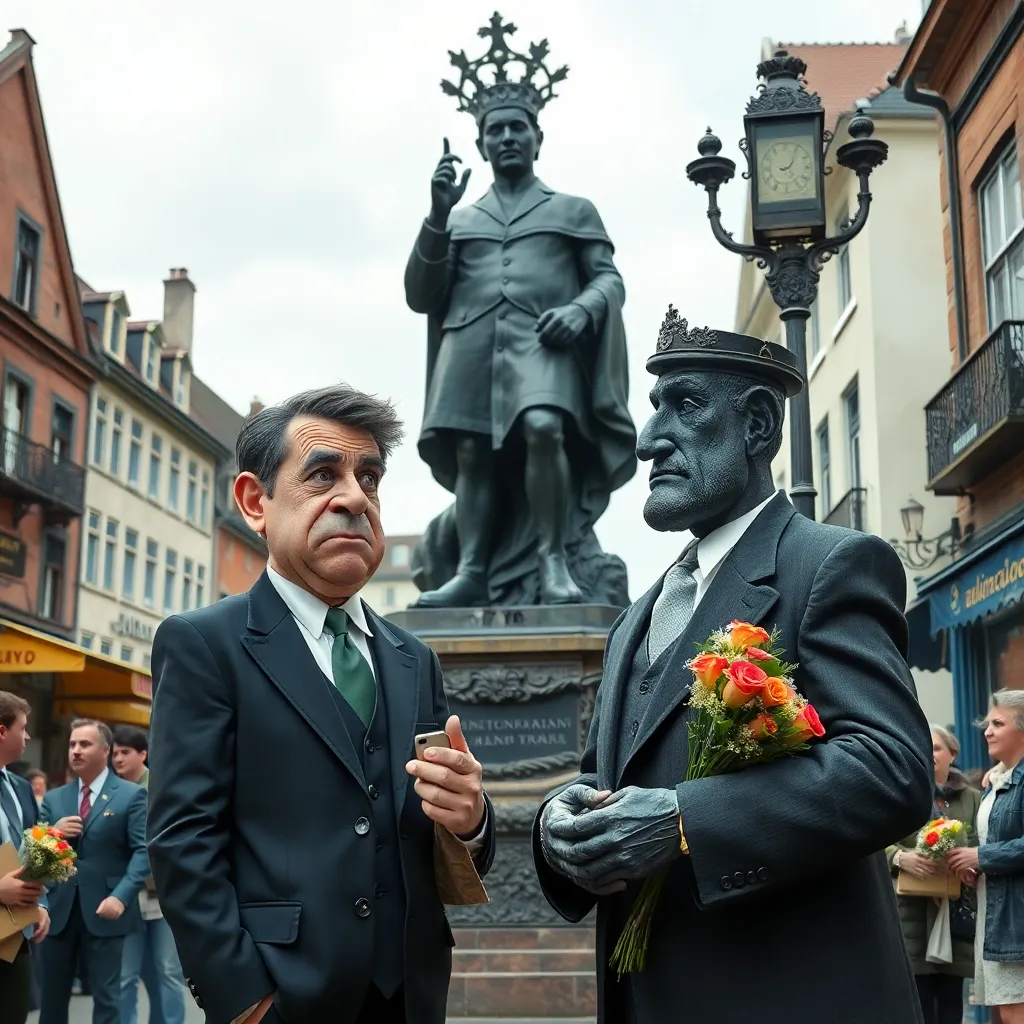
Experts have offered competing explanations. Dr. Lionel Voss, professor of Monument Studies at the University of Greater Slabchester, suggested thermal expansion may have “activated a latent commemorative conscience,” a phenomenon he admitted has never been recorded but described as “emotionally plausible.” Meanwhile, a local spiritualist blamed “pent-up gratitude,” arguing the statue had absorbed decades of civic projection and was now releasing it in the form of impossible candor.
A more practical theory emerged from town archivist Edith Nib, who discovered a folded paper sealed inside the monument’s original design documents. The note, believed to be written by sculptor Armand Bell, reads: If they insist on making him heroic, let him at least be useful.
“This does rather reframe things,” Nib said. “Bell was known for realism. He once made a bust of a magistrate so honest the man resigned.”
Not everyone is upset. A growing number of residents have begun scheduling deliberate walks past the statue in hopes of receiving further personal direction. By mid-afternoon, a queue had formed stretching past the chemist and around the fountain, with people clutching notebooks, iced coffees, and expressions normally associated with tax audits.
“I just want closure,” said Hannah Pike, 31. “Or a vegetable-based framework. I’m not picky.”
When her turn came, the statue paused for several seconds before declaring: “You are trying to become the kind of woman who owns linen. Begin by returning the yogurt maker.”
Pike wrote this down and called it “transformative.”
The town’s youth have embraced the phenomenon with customary opportunism. Several teenagers have started a side business offering “pre-coaching debriefs” for anyone about to enter the square. For £5, they will guess what the statue is likely to say based on your shoes, posture, and whether you say “circle back” in civilian contexts. Reviews have been mixed, with one customer complaining the service simply told him, “You already know.”
Religious leaders have also weighed in. Reverend Paul Stitch of St. Bartholomew’s described the statue as “pastorally intrusive,” while conceding that attendance at morning reflection had risen sharply since the monument called the entire 9 a.m. congregation “spiritually over-accessorized.”
Even the police have found themselves unable to intervene effectively. Sergeant Moira Flint confirmed officers approached the statue at 2:20 p.m. to assess whether any laws were being broken, only to be told, “Authority is not the same thing as having finished your paperwork, Moira.”
“We withdrew,” Flint said. “Not because we had to. Just… administratively.”
The situation escalated in the early evening when the statue began offering group advice by category.
“Men who say they’re ‘not great texters,’ gather near the fountain,” it boomed. “We begin with honesty.”
Witnesses say a visible tremor passed through at least six pubs.
Then came the cyclists, whom the statue accused of “weaponizing fluorescent fabric.” Then the amateur ukulele club, informed they had “confused persistence with permission.” Then a cluster of estate agents, who were told in a voice of such majestic weariness that bystanders applauded: “Open-plan is not a moral virtue.”
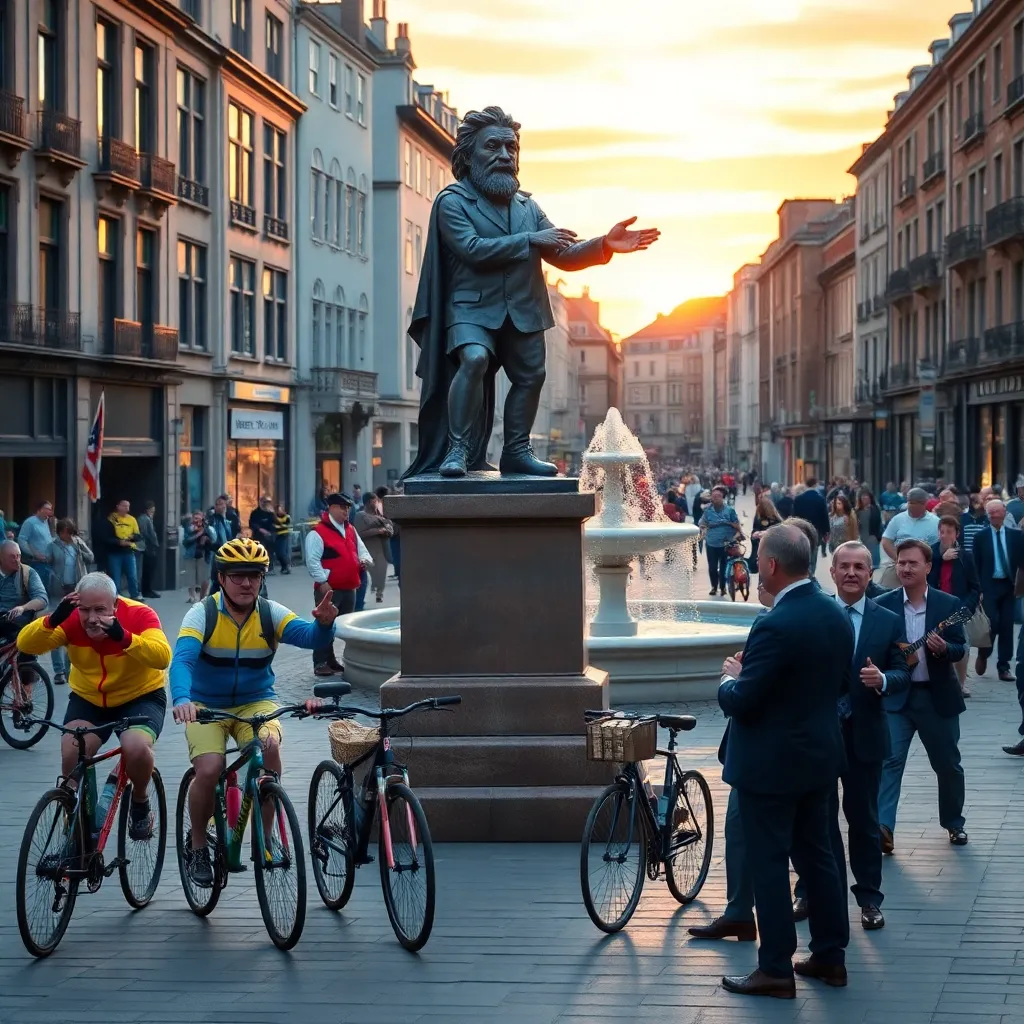
By nightfall, Market Square had taken on the atmosphere of a public intervention hosted by a war memorial. Food vendors did brisk trade in stress pastries and fortified tea. A busker attempted to drown out the statue with an accordion rendition of Total Eclipse of the Heart, but was told, with devastating gentleness, “You are not actually expressing yourself, Colin. You are leaning on volume.”
He stopped at once.
The council has announced a temporary cordon around the monument while officials determine next steps, though several residents have already begun petitioning to preserve the statue in its current state. One online campaign, titled Let Greg Finish, amassed 14,000 signatures in three hours, mostly from people who believe nearby towns “could do with a turn.”
There is also talk of expanding the concept. A neighboring parish reportedly inquired about installing advisory gargoyles on the library. One county planner proposed replacing expensive consultant reports with “a stern plaque that knows your patterns.” No budget has yet been approved, though enthusiasm remains high among those who have recently been told to stop starting hobbies with equipment purchases.
As for the statue itself, it showed no sign of fatigue late last night. Under moonlight, standing rigid above the square it has quietly dominated for generations, Bronze Greg continued his work, correcting posture, confronting avoidance, and absolutely dismantling a man from Accounts over his use of the phrase “going forward.”
At press time, the statue had issued only one broad statement regarding its intentions.
“You asked for a hero,” it declared to the square. “You got accountability.”