Man Bursts Into Hospital, Speaks To Receptionist, Immediately Discovers The Emotional Invoice
At 9:14 a.m. on what staff are now calling "an unfortunately energetic Tuesday," local man Darren Pibble, 42, entered St. Agatha’s Municipal Hospital with the velocity and conviction of someone who had recently become certain that doors were merely decorative suggestions.
Witnesses say Pibble flung open the sliding entrance doors so aggressively that they briefly reconsidered their entire profession, then strode toward reception in a state best described by experts as "one button away from total collapse."
"He came in breathing like a steam train being audited," said receptionist Lorna Mews, who has now seen everything except a straightforward insurance form. "He slapped both hands on the desk and said, 'I need to speak to a doctor immediately.' So I said, 'That is, in a broad sense, what hospitals are for.'"
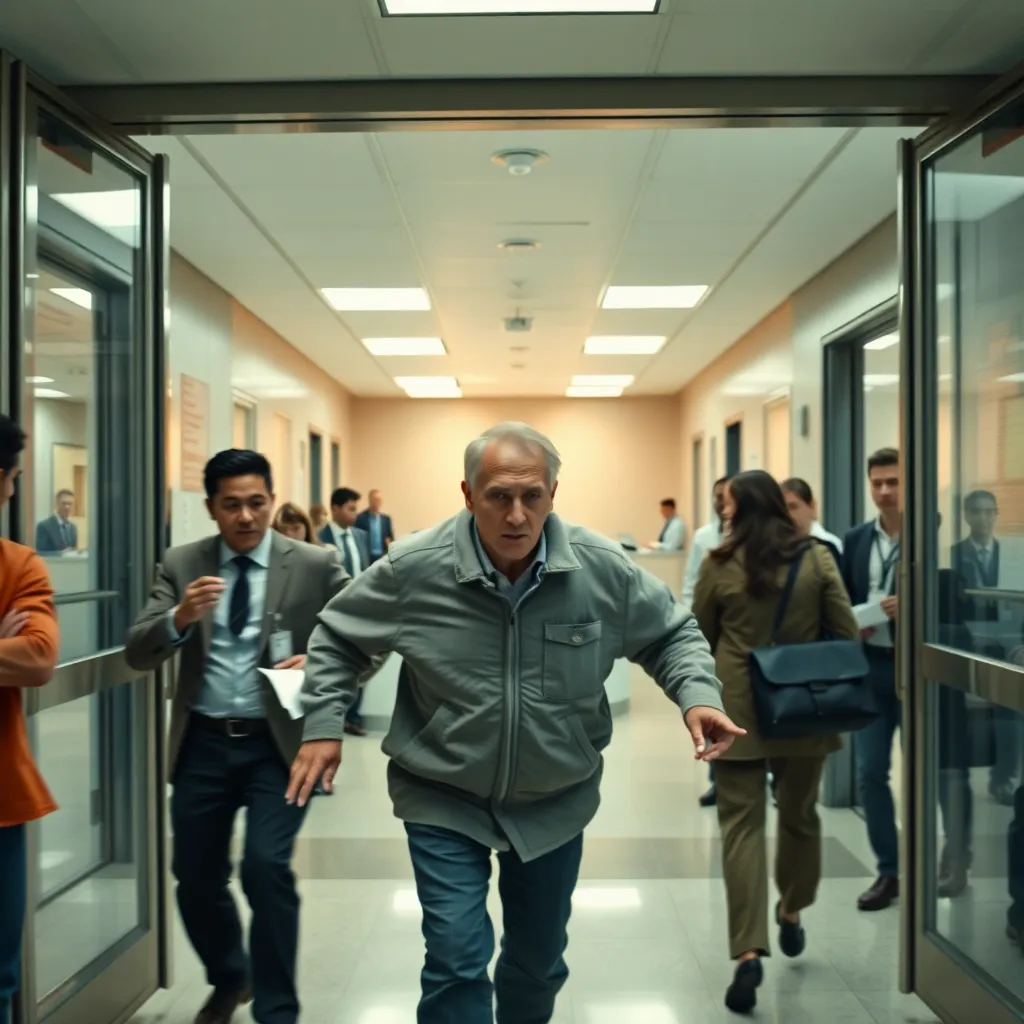
According to those present, the conversation began with the traditional hospital rhythm of urgency colliding with clipboards. Pibble reportedly refused to sit down, refused to take a number, and refused to answer whether he was the patient, insisting only that "time is a hunted animal" and that "someone in this building has a stethoscope and therefore destiny."
After several attempts to establish whether he was bleeding, unconscious, contagious, or merely theatrical, Mews contacted Dr. Neville Croot, a senior physician known for his professionalism, his crisp handwriting, and a facial expression suggesting he was perpetually reading a disappointing email in his mind.
Dr. Croot emerged from the corridor moments later, still wearing gloves and the look of a man who had just left one crisis to pick up another in the lobby.
"I asked him what seemed to be the problem," Croot told reporters, standing beneath a wall poster that cheerfully encouraged handwashing with the menace of a threat. "He looked at me, paused for what I can only describe as a dramatic amount of time, and said, 'Doctor, I have lost something.'"
At this point, staff prepared for any number of possibilities, including memory, motor function, a family member, or a surprisingly important toe.
Instead, witnesses allege Pibble reached into his coat pocket and produced a small laminated ticket, a grocery receipt, two cough sweets, and finally the expression of a man arriving at the cliff edge of his own administrative disaster.
"He said he had lost his parking token," Mews confirmed, with the flat serenity of a person whose soul had quietly moved to the countryside years ago. "Not his car. Not consciousness. The little validated token from the machine."
The hospital lobby then experienced what several bystanders described as "a silence so complete you could hear an orchid giving up."

For Dr. Croot, however, the incident would not end as a mere interruption. In what colleagues are calling a devastating secondary development, the physician reportedly felt an immediate and profound loss of something far more irreplaceable: the final usable fragment of his patience.
"Neville just sort of blinked," said junior nurse Priya Bell. "You could see it happen in real time. One minute there was a doctor standing there, and the next there was a man witnessing the death of a private inner civilization."
Croot himself declined to characterize the moment as a breakdown, calling it instead "an administrative bereavement."
"There are years in medicine when you lose sleep, innocence, work-life balance, and any clear memory of lunch," he said. "But this was different. A man looked me in the eyes during a functioning hospital emergency intake and asked me, with complete sincerity, whether I could 'scan the floor around radiology for a little blue coin thing.' Something left me in that moment. I do not expect its return."
Sources say Pibble remained adamant that his case warranted immediate physician involvement because, in his words, "if I can’t get the token back, parking becomes twenty-two pounds, and frankly what is healthcare if not preventing further suffering?"
This argument reportedly caused one elderly visitor to nod thoughtfully and say, "He has a dark sort of point."
What followed was a surreal procession through the hospital’s ground floor, with Pibble leading Dr. Croot, the receptionist, one porter, and eventually two unrelated members of the public on a solemn pilgrimage past cardiology, vending machines, and a potted plant that had seen enough.
The search expanded after Pibble announced he may have dropped the token "either near the lift, the gift shop, or while having a meaningful panic by the orthopedics sign."
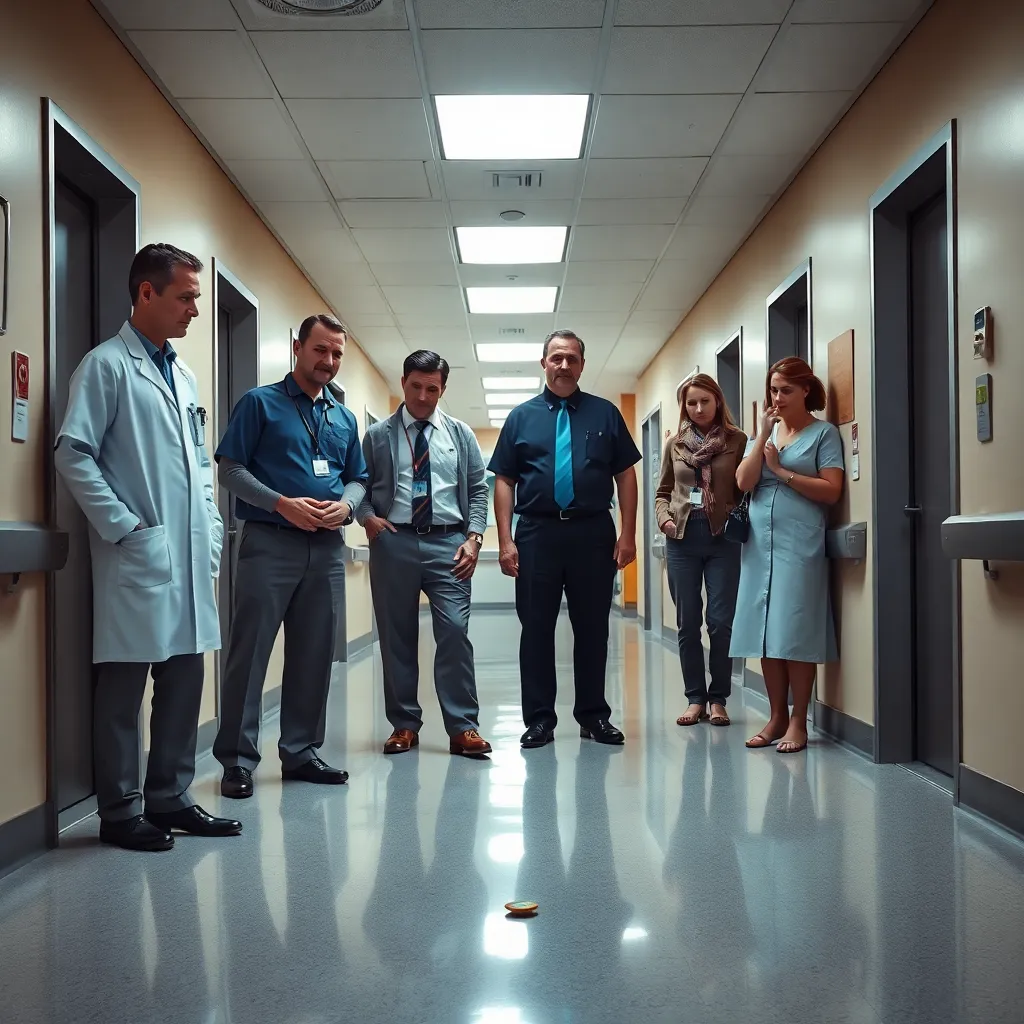
Hospital staff later confirmed that no parking token was found, though the search did uncover three paperclips, a button, a raisins packet of uncertain age, and what management described delicately as "a level of institutional vulnerability we had not planned to examine before noon."
The true blow came when parking services informed Pibble that, without the token, he would be charged the full daily rate.
Witnesses say the man staggered backward upon hearing the amount, removed his glasses, and whispered, "Then it is as I feared," in the tone usually reserved for prophets, admirals, and men opening utility bills.
At this, Dr. Croot reportedly placed one hand on the wall for support and murmured, "I can treat organs. I can restart hearts. But I am defenseless before municipal pricing structures."
Employees say the doctor then excused himself, returned to his office, and spent seven uninterrupted minutes staring at a diagram of the liver as though trying to remember whether civilization had been a mistake.
By mid-afternoon, the hospital had resumed normal operations, if "normal" includes several staff members spontaneously checking their own pockets every six minutes and one volunteer weeping softly near the volunteer desk "for reasons that seem larger than the event itself."
Pibble was eventually seen leaving the premises on foot, carrying his parking receipt like a military condolence letter and moving with the solemn dignity of a man who had gone to a hospital seeking mercy and discovered only tariffs.
In a brief statement, hospital administrators reminded the public that medical staff are available for urgent health concerns and are "not, except under extraordinary circumstances, detectives for tiny pieces of parking infrastructure."
Dr. Croot, meanwhile, has returned to work but is said to be changed.
"He still does his rounds. He still speaks kindly to patients," said Nurse Bell. "But now, whenever someone says they've 'lost something,' he takes a very deep breath first and looks out the window like a widower in a coastal drama."
At press time, a small blue parking token had been found in Darren Pibble’s other coat pocket, where it had apparently been resting all day, warm, silent, and entirely committed to the destruction of human trust.