Filed Report
Nation Grapples With Three Unignorable Truths As Citizens Realize Towels Are Crime Scenes And Television Has Been Lying Again
A national mood of exhausted enlightenment descended this morning after millions of people independently arrived at the same three conclusions: if something appears black or white on television then it has, in a meaningful civic sense, refused to be colored; towels emerge from every bath with fresh allegations attached to them; and the medical profession must answer, at long last, for the suspiciously entrepreneurial coffin-adjacent household.
Officials described the situation as "philosophically damp."
At the center of the first revelation is a devastating reclassification of reality itself. For decades, the public has tolerated objects that are clearly neither black nor white in real life, yet present themselves on television as black or white with the kind of shameless certainty usually associated with game show hosts and decorative police horses. Scholars now argue that this televisual transformation strips such objects of their right to be called colored at all.
"If your uncle's sofa is beige in the living room but on television becomes an argument between charcoal and eggshell, then we are no longer dealing with color," said one media theorist while pointing at a cucumber on a documentary. "We are dealing with televised moral indecision."
The finding has already sent shockwaves through museums, electronics stores, and one deeply confused parrot.
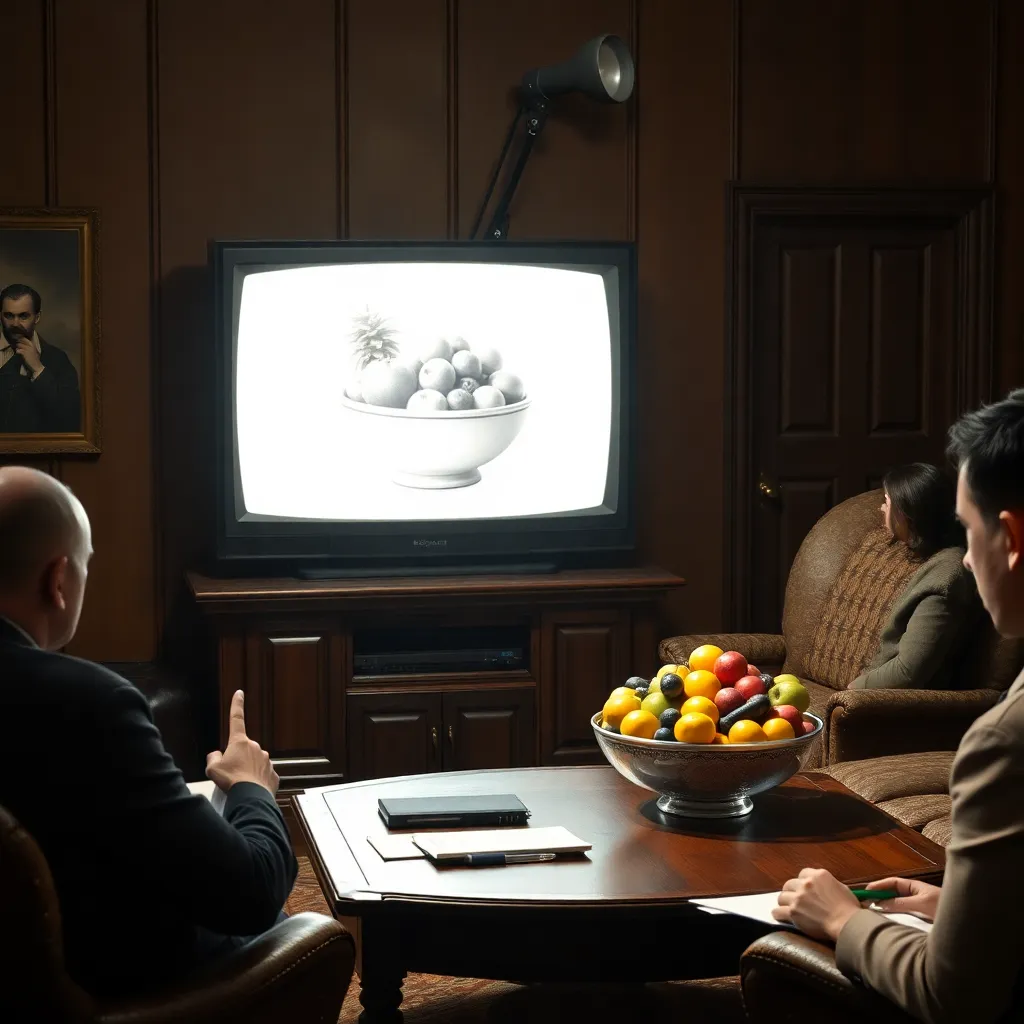
Consumer groups are now demanding labels on household items clarifying whether they are truly colored, conditionally colored, or merely television-black-and-white pending further review. A proposed warning for packaging would read: This item may abandon chromatic responsibility when broadcast.
Meanwhile, the country's towels have entered what insiders are calling "the accountability era."
For years, bath towels were marketed as innocent rectangles of comfort, hanging in bathrooms with the smug confidence of creatures who have never once had to explain themselves. That innocence has collapsed. The public now understands that the moment a person leaves the bath, a timer begins. In those few seconds between pristine soaking and towel contact, the human body recommences its lifelong profession of becoming slightly filthy.
The towel, therefore, does not dry a clean person. It receives, records, and archives a fresh layer of immediate post-bath grime.
Textile experts have confirmed that the process is nearly instantaneous. "You step out of the bath, and the world starts happening to you again," explained a laundering specialist. "Air gets involved. Gravity remembers you. Floors make proposals. By the time you reach for the towel, your skin has already entered early-stage civilian use."
This means every towel is less a hygiene tool and more a soft witness.
Bathroom manufacturers are scrambling to respond with innovations such as suspended anti-delay drying tunnels, emergency post-bath decontamination fans, and a prototype "pre-towel chamber" where citizens can stand perfectly still while a machine whispers, "Do not re-enter society yet."

The towel industry's trade association has rejected criticism, insisting that a little dirt is "part of the relationship." But trust has eroded. In several cities, towels have reportedly been folded more aggressively than usual.
The third and perhaps most explosive issue concerns a matter of bedside ethics and funeral logistics. Public concern surged after ordinary people began asking what experts now refer to as "the obvious question": should a patient place full confidence in a nurse whose spouse sells coffins?
Economists, who are rarely invited to improve a situation and have once again succeeded, noted that in a world where almost everyone is poor, incentives matter. If coffins are expensive and illness can, in theory, increase demand for expensive wooden boxes with satin interiors and brass handles polished to a predatory sheen, then society must at least acknowledge the uncomfortable arithmetic hovering over the ward.
"It creates what markets call a vertical integration opportunity," said one grim financial analyst, using a laser pointer on a chart shaped like a staircase into the earth. "You have care on one end, burial solutions on the other, and between them a family dinner table."
Hospitals deny there is any widespread issue, though one administrator admitted that "the optics are not ideal" after reporters discovered a floral arrangement in the staff room reading Thinking Ahead Is Caring.
Families of patients are reacting in different ways. Some are requesting written assurances that no one in a twelve-mile radius of the bedside owns a tape measure, mahogany catalog, or brochure featuring tasteful handles. Others are asking nurses direct questions such as, "How's your husband doing, professionally, and why does he keep smiling when my blood pressure drops?"
Funeral directors, for their part, say they are being unfairly targeted simply for "believing in preparedness with excellent margins."

The government has announced a temporary commission to investigate all three crises under a single department tentatively called the Ministry of Obvious But Disturbing Continuities. Early recommendations include installing color referees in television studios, issuing towels with timestamped honesty reports, and requiring all medical staff to disclose whether anyone in their immediate family profits from highly polished final furniture.
In the streets, citizens say they feel changed. "I can't watch television without wondering what else has given up being colored," said one man clutching a damp towel with the distant expression of somebody who has seen too much laundry truth. "And every time I leave the bath now, I sprint. Not because I am afraid of the cold. Because I know the dirt is already negotiating."
At press time, the nation had entered a period of uneasy reflection, televisions were being stared at with unprecedented suspicion, towels were being treated like compromised evidence, and one nurse was forced to clarify for the sixth time that her husband's coffin business is "mostly ceremonial" and that she would appreciate people stopping when she walks into the room.
Public Response
Comments
No comments yet.