Filed Report
Party Hat Found on Mars Triggers Interplanetary Diplomatic Headache
The scientific community was thrown into ceremonial disarray this morning after a rover on Mars transmitted photographs of what experts have identified, with increasing panic, as a **party hat**.
The object, discovered half-buried in red dust near a modest rock formation that NASA had previously described as "geologically interesting" and now describes as "possibly festive," appears to be a classic cone design with faded stripes and what one senior researcher called "a suspiciously jaunty tilt." Initial attempts to classify it as an unusual mineral deposit collapsed when somebody in mission control enhanced the image and noticed what may be a frayed elastic chin strap.
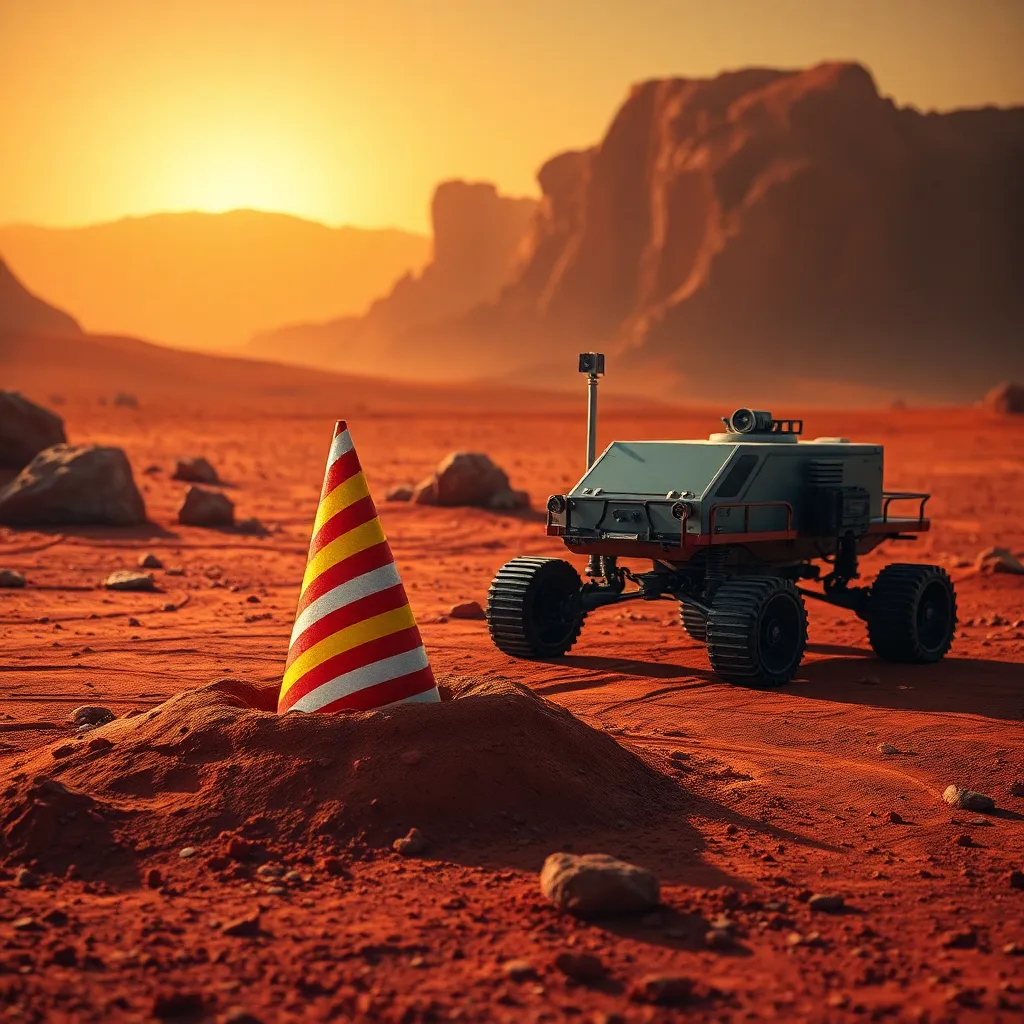
Within minutes of the announcement, world leaders demanded answers to questions nobody had previously thought to ask, including: Who held the party, why were Earth not invited, and whether Mars has been quietly enjoying a better social life than previously reported.
At a hastily assembled press conference, planetary scientists stood in front of several charts they clearly had not prepared for this specific occasion and explained that there are currently four leading theories. The first is that the hat arrived via contamination from Earth, perhaps attached to an early probe by "an intern with a birthday." The second is that ancient Martian civilization reached its cultural peak in the field of novelty headwear before disappearing mysteriously, perhaps during a disagreement over cake allocation. The third theory suggests a cosmic prank of unknown scale. The fourth, delivered in a much smaller voice, is that Mars may still be inhabited by entities who understand celebration but not cleanup.
Social media users responded with characteristic restraint by declaring the hat proof of aliens, proof of anti-alien coverups, proof that Elon Musk had already been there, and proof that the universe is fundamentally run by event planners. Conspiracy forums lit up with detailed claims that the cone is not a hat at all but an "antenna of joy," designed to beam invitations directly into the human subconscious. Several users said they had always felt a calling to wear glitter on Tuesdays and now considered themselves vindicated.

NASA, attempting to preserve order, released a carefully worded statement saying the agency is "committed to following the evidence wherever it leads, even if it leads to a child's birthday aesthetic." Officials further clarified that no candles, balloons, or suspicious traces of frosting have yet been detected in the surrounding area, though one rover wheel did pass over a patch of terrain now unofficially referred to as "possible confetti."
Meanwhile, the European Space Agency urged calm and professionalism, then quietly redirected three telescopes and one extremely eager graduate student toward the discovery site. The student, who has not slept in 19 hours, reportedly believes the hat’s angle could reveal prevailing wind patterns, subsurface ice distribution, and whether Martians preferred upbeat music.
Military analysts were less comfortable. If the hat proves to be recent, it would indicate either unregistered activity on Mars or the existence of a civilization capable of both surviving on a hostile planet and organizing themed gatherings without alerting Earth. One defense official, speaking anonymously, said, "If they’ve got party infrastructure, they’ve got logistics. If they’ve got logistics, we have to consider the possibility of a banquet chain of command."
Economists have also entered the conversation, because they always do. Markets fluctuated wildly as investors poured money into aerospace firms, novelty goods manufacturers, and a startup claiming to develop "premium extraterrestrial celebration solutions." By afternoon, speculators had already coined the term space decor sector, a phrase expected to ruin several board meetings by the end of the week.

Public reaction has been divided. Some citizens expressed wonder at the possibility that humanity is not alone and that elsewhere in the cosmos, beings also buy regrettable decorative supplies. Others demanded immediate funding for a crewed mission to Mars, not for scientific reasons, but to determine whether there is still dip.
Children, in perhaps the most mature response observed so far, simply accepted the news and moved on. "Yeah," said one eight-year-old from Manchester, "space is big. Someone probably had a birthday." The remark has since been praised as the most coherent summary yet produced by the international community.
As evening fell, mission teams continued to study the enigmatic headpiece, zooming in on every crease, grain of dust, and shadow. There is talk of sending the rover closer, though engineers are concerned that if the vehicle approaches too fast, etiquette may require it to bring a gift.
For now, the hat remains where it was found: silent, windswept, and radiating the unnerving confidence of an object that knows more than it is saying. Whether it is a relic of ancient Martian revelry, a modern accident, or the opening move in the galaxy’s most passive-aggressive invitation campaign, one thing is certain.
Humanity has spent centuries staring at Mars and asking whether life was ever there. It did not occur to anyone that the better question might be whether it had already started without us.
Public Response
Comments
No comments yet.