The Rise of the Pillow People: A Cozy Revolution That’s Somehow Legally a “Movement”
WIBBLE CITY, UK — What began as a quiet lifestyle choice involving a tasteful scatter cushion and a “just in case” throw has erupted into a full-blown societal upheaval: the rise of the Pillow People, a rapidly expanding group of citizens who believe the world would be significantly improved if everyone simply lay down for a bit and stopped making everything so loud.
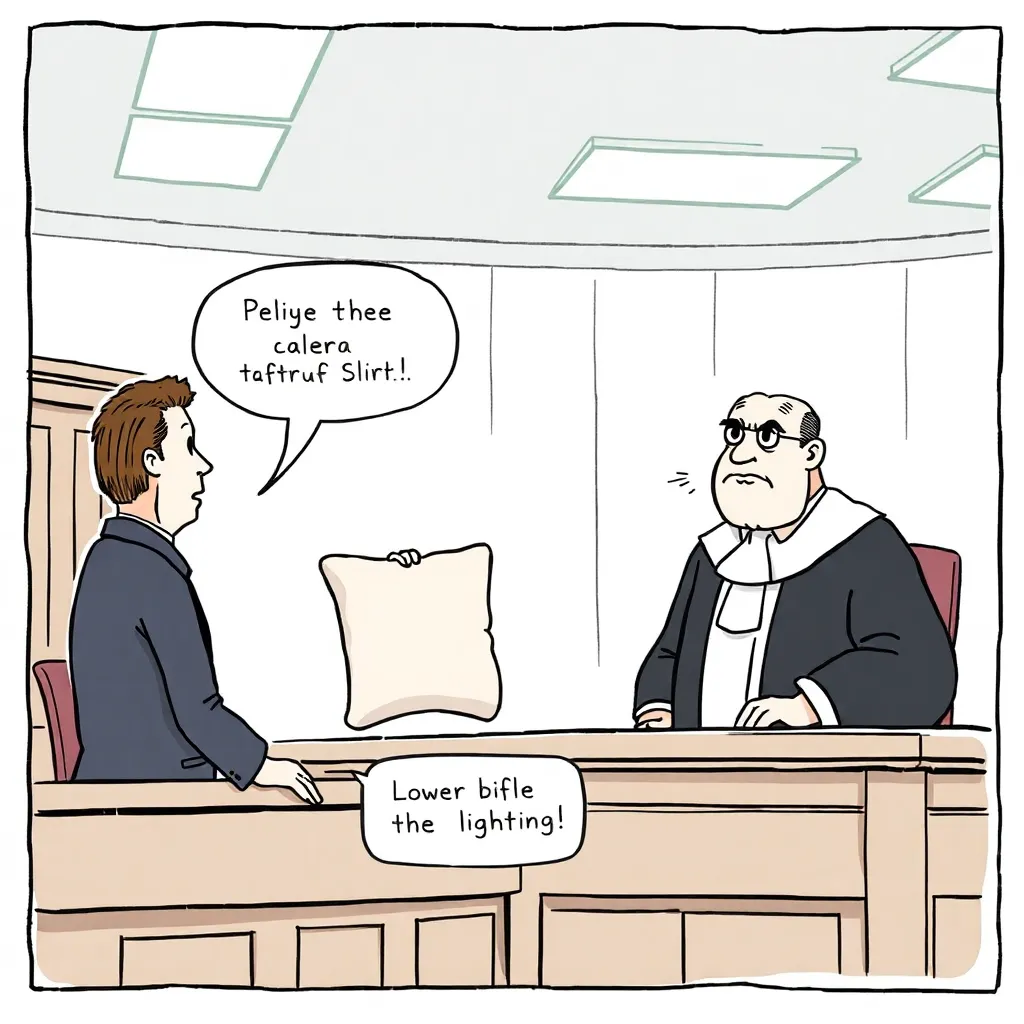
Once dismissed as “tired” and “probably dehydrated,” Pillow People are now organising, lobbying, and—most controversially—bringing their own cushions to public meetings, restaurants, and, in one case, a courtroom, where a defendant reportedly asked if the judge “could lower the lighting because it’s giving ‘aggressive office.’”
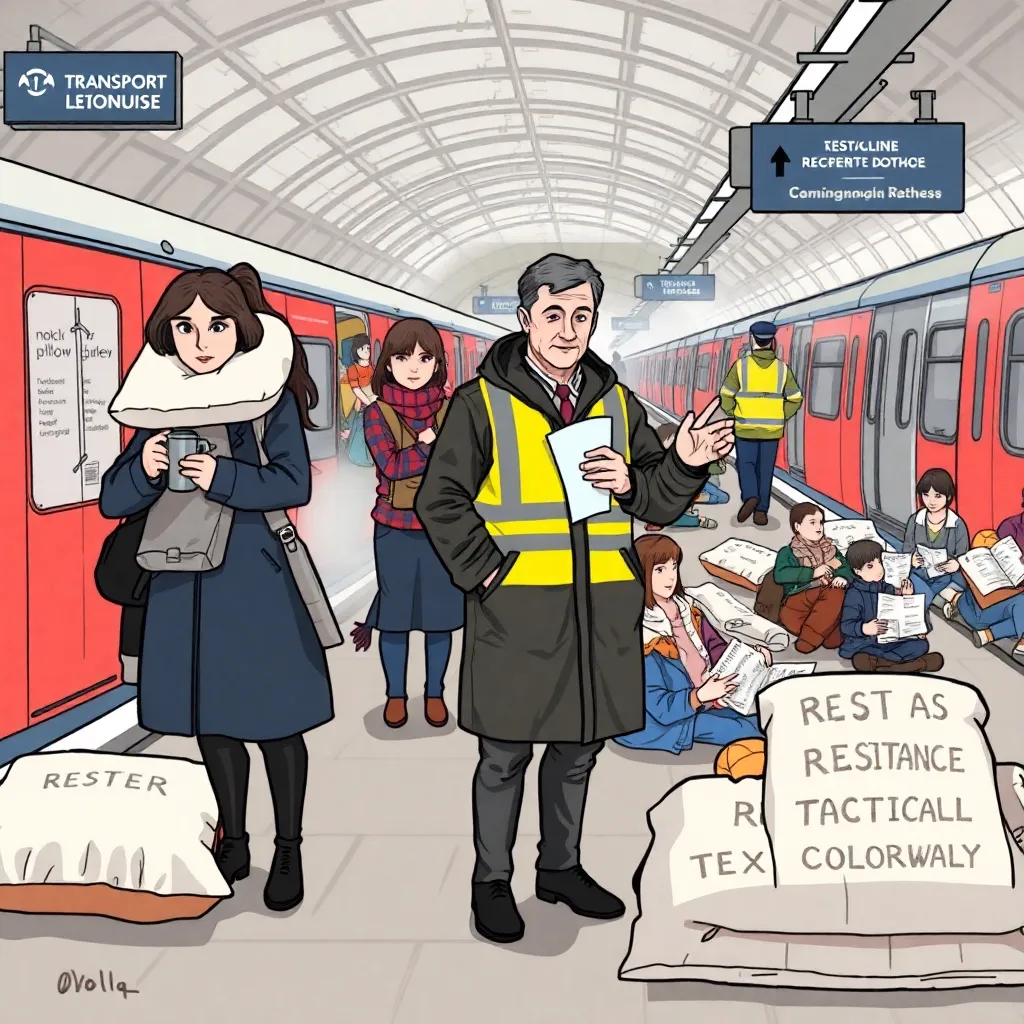
Authorities say they first noticed the movement when a growing number of commuters began arriving at train stations carrying not bags, but bed configurations. “At first we thought it was a new type of protest,” said Transport Liaison Officer Darren Pymm, gesturing toward a platform now dotted with neck pillows, lumbar rolls, and what appears to be a full duvet “in a tactical colorway.” “But then they started offering each other chamomile and talking about ‘rest as resistance.’ That’s when we knew we were dealing with something organised.”
From Soft Furnishings to Hard Politics
The Pillow People insist their movement is not about laziness, but about “reclaiming comfort from the tyranny of productivity culture.” Their manifesto—printed on recycled linen, naturally—demands:
A national “mandatory lie-down” period between 1:00 and 2:30 p.m.
Replacement of handshakes with “consensual blanket tucks”
A complete ban on chairs described as “visually minimalist but emotionally violent”
Reclassification of “hustle” as a controlled substance
They’ve also begun running candidates in local elections under the banner Cushion First, with campaign posters featuring soft-focus portraits of smiling citizens cradling memory foam like it’s a rescue animal.
“We’re not saying nobody should work,” said movement spokesperson and self-described “comfort strategist” Melinda Hush. “We’re saying the world should stop acting like a person’s worth is measured in how little they sleep and how many emails they send at 11:47 p.m. Also, why are office chairs shaped like they’re mad at you?”
Asked whether the Pillow People have a coherent economic plan, Hush said, “We do. It’s called resting. That’s when the body does repairs, the mind does processing, and the spirit stops screaming into the void.”
The Science of Being Extremely Cozy
Experts are split. Sleep researchers admit the Pillow People are not entirely wrong, but are concerned about the movement’s growing tendency to treat every minor inconvenience as a medical emergency requiring immediate horizontal positioning.
“We’ve seen a significant rise in citizens claiming ‘acute standing fatigue’ after waiting in a queue for more than four minutes,” said Dr. Helena Graves, a neurologist who has recently added “pillow etiquette” to her patient intake forms. “Is rest important? Yes. Should we be bringing full body pillows to the supermarket? That’s… less clear.”
Meanwhile, a rival faction known as the Firm Mattress Traditionalists argues the Pillow People have gone too far. “Comfort is fine,” said their leader, who introduced himself only as “Graham, 56, Orthopaedic Loyalist.” “But if society becomes too soft, we lose structure. People will start talking about their feelings unprompted. You’ll have chaos. You’ll have throw blankets in summer.”
Graham then handed reporters a leaflet titled “A Straight Spine Is a Straight Mind” and walked away with the stiff dignity of a man who has never enjoyed a nap.
The Workplace Goes Soft (Against Its Will)
Businesses are struggling to adapt. In response to Pillow Person demands, several corporations have introduced “rest pods,” though employees report these are typically converted storage cupboards with a beanbag and a laminated sign reading PLEASE DO NOT SLEEP LONGER THAN EIGHT MINUTES.
“One of our staff asked if we could replace the quarterly performance review with a ‘quarterly lie-down reflection,’” said HR manager Natalie Briggs, blinking rapidly as if trying to expel the memory. “They wanted to discuss their ‘emotional alignment’ with the company’s mission while under a weighted blanket.”
Other companies have leaned in. A trendy marketing agency in Shoreditch has introduced a “Snooze Sprint,” where employees sleep for 20 minutes and then wake up to brainstorm slogans that sound like they were written by a dream. Early outputs include: “Brand, But Make It Whisper” and “Synergy, Softly.”
Not all industries can accommodate the shift. Construction firms remain sceptical. “I’m not against pillows,” said foreman Liam Oates. “But you can’t really pour concrete and do a little nap in the middle. You can try, but then you wake up and you’ve poured concrete on your legs and now you live like that.”
A New Kind of Protest: Sit-Ins Become Lie-Ins
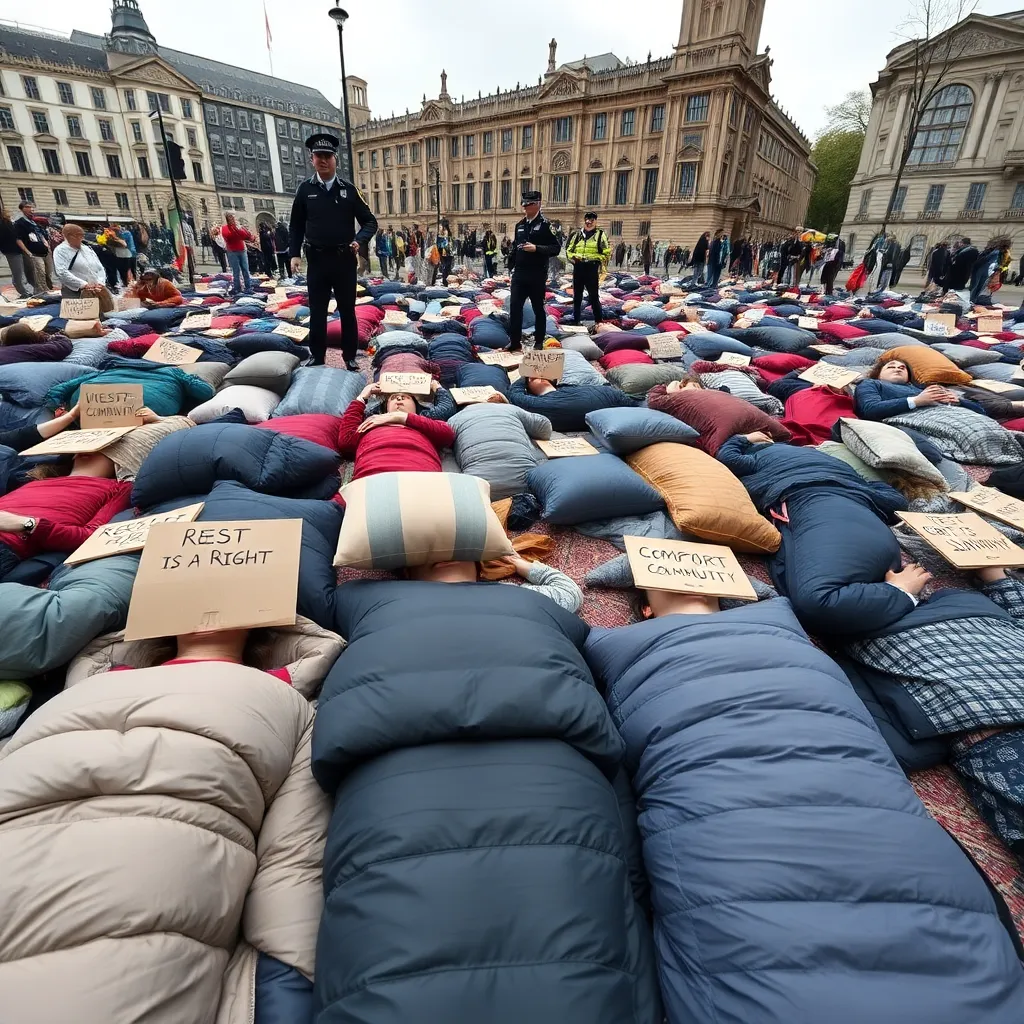
The Pillow People’s preferred demonstration tactic is the “lie-in,” in which protesters occupy public spaces by lying down quietly and insisting that their bodies “will not rise until society lowers its expectations.”
Last weekend, hundreds staged a lie-in outside Parliament, forming a vast patchwork of duvets and moral certainty. Police attempted to disperse the crowd, but were reportedly disarmed by the protesters’ calm tone and the fact that one officer accepted a spare cushion “just to hold, not in a political way.”
“It’s hard to escalate when everyone is speaking in soothing voices,” admitted a senior police source. “They keep offering you lavender spray. It’s not aggressive. It’s… disorienting.”
The lie-in ended peacefully after organisers announced it was “time for a gentle transition,” and participants rolled themselves up like contented burritos and departed.
The Great Cushion Shortage
Retailers are feeling the impact. Major homeware chains report that pillows are selling out nationwide, and not just the decorative ones. “They’re buying all of them,” said one store manager. “Neck pillows, pregnancy pillows, travel pillows. Someone asked if we had a ‘pillow for existential dread’ and then cried softly into a display of bath mats.”
Online marketplaces are flooded with listings for “revolution-grade cushions” and “protest-ready duvets,” some with built-in pockets for snacks and laminated copies of the Pillow People’s three core principles:
Rest is a right.
Comfort is community.
If it’s scratchy, it’s suspicious.
Prices have spiked. A black market has emerged in certain suburbs where smugglers trade memory foam toppers under the cover of darkness. One anonymous seller described the demand as “unprecedented, but also kind of chill.”
Government officials are reportedly considering a Strategic Pillow Reserve. “National resilience depends on preparedness,” said one minister. “And frankly, after last year, everyone deserves a little lie down.”
Cultural Fallout: Fashion, Dating, and the End of Hard Pants
The Pillow People are also reshaping culture. Fashion has embraced the movement with “napwear,” a style characterised by elastic waists, soft fabrics, and a refusal to apologise.
Hard trousers are in decline. Belts have been described as “waist oppression.” Button-up shirts are tolerated only if “they don’t feel like an argument.”
Dating has changed, too. Pillow People have popularised “horizontal courtship,” in which two people get to know each other while reclining and discussing their boundaries, their sleep schedules, and whether their emotional attachment style is “more like a body pillow or more like a throw you forgot you owned.”
“I used to think romance was about excitement,” said one Pillow Person on a park bench, nestled into a cushion with the serene intensity of someone who has never been truly startled. “Now I think it’s about someone bringing you a blanket without being asked.”
The Opposition Responds: “Stand Up for Standing Up”
Predictably, backlash has arrived. A counter-movement called Upright Britain claims the Pillow People are undermining national character.
“This is a slippery slope,” said Upright Britain founder Malcolm Reeve, standing in what appeared to be deliberate defiance of comfort. “First it’s pillows in the workplace, then it’s duvets on public transport, then suddenly nobody knows how to make small talk without asking permission.”
Reeve warned that softness leads to weakness, and weakness leads to “people saying ‘no’ to overtime,” a scenario he called “economically catastrophic.”
His rally, titled “Stand Up for Standing Up,” drew seven attendees and one confused dog. It ended when someone asked if they could sit down for a minute.
What Happens Next?
Sociologists believe the Pillow People are tapping into a deep cultural hunger for gentleness. “Modern life is loud, fast, and punishing,” said Professor Asha Lind, who has spent the last month embedded with a group of activists in a community nap space. “The Pillow People offer a radical alternative: softness as a form of power.”
Lind added that the movement’s success will depend on whether it can maintain momentum without collapsing into what she termed “extreme coziness,” a state in which a person becomes so comfortable they can no longer remember what they were resisting, only that the blanket is good.
The Pillow People, for their part, seem unconcerned. When asked how they plan to sustain the revolution, spokesperson Melinda Hush simply adjusted a cushion beneath her elbow and said, “We will endure. Quietly. With snacks. And with lumbar support.”
At press time, reports indicated the movement was preparing its boldest action yet: a nationwide petition calling for the replacement of all alarm clocks with a gentle whispering voice that says, “If you can, stay.”
Critics argue this would cripple the economy. Supporters say the economy could use a nap.
Either way, one thing is clear: the Pillow People are not going away.
They’re lying down and staying there.