The Three Alleged Overthrows of America by Biden: A Deep Dive Into Political Narratives
WASHINGTON—In a nation where every election is either “the dawn of a new era” or “the last normal Tuesday we’ll ever have,” President Joe Biden has been accused—often in the same 48-hour news cycle—of overthrowing America no fewer than three times.
Not winning it. Not governing it. Overthrowing it. Like a velvet coup, but with more Amtrak nostalgia and fewer tanks.
To understand how a president can allegedly topple a superpower multiple times without interrupting the early-bird dinner schedule, The Wibble has undertaken an exhaustive investigation into the three main “Biden overthrows” currently circulating through the political bloodstream, from cable news panels to forwarded emails titled “READ THIS BEFORE IT’S DELETED!!!”
We approached this like serious journalists: by reading a lot of internet posts, watching too many clips that start mid-sentence, and consulting a scholar who lives inside a ring light.
Overthrow #1: The “Coup-by-Policy” Allegation (Also Known as: “He Passed a Thing”)
The first alleged overthrow is the most old-fashioned: Biden is accused of overthrowing America by doing government.
In this narrative, the coup unfolds not with a bang, but with a briefing:
Signing legislation
Issuing executive orders
Appointing officials
Proposing budgets
Saying words like “infrastructure” with unsettling sincerity
This is framed as an ideological regime change, in which a familiar America is replaced with an unfamiliar one where roads are repaired and some people receive letters from the IRS that are actually from the IRS.
“The founders never intended for a president to use the levers of government,” explained Dr. Tally Hoaxworthy, Senior Fellow at the Jefferson Institute for Being Mad Online. “They intended gridlock, vibes, and a modest agrarian economy where everyone is a lawyer who also farms.”
How the narrative works
This overthrow has a reliable structure:
Select a policy (vaccines, student loans, climate, immigration, taxes, federal agencies existing at all).
Describe it as unprecedented tyranny, preferably using the phrase “like we’ve never seen before,” which is convenient because most people can’t remember what happened last week.
Forecast imminent collapse (currency gone, borders open, gas lines, martial law, mandatory tofu).
When collapse does not occur, switch to “they’re hiding it.”
The genius of this approach is that it doesn’t require a literal overthrow—only the sense that something has been taken away, like the right to never encounter a new rule.
The key emotional fuel: “I didn’t vote for this”
Many supporters of this narrative insist Biden’s agenda represents an illegitimate seizure of national identity.
“I didn’t vote for a country where my kid’s school talks about feelings,” said one man in a parking lot, pausing only to open a browser tab titled “How to get rid of property taxes forever.”
Of course, other Americans counter that elections have consequences and that policy outcomes are, in fact, the point.
This is immediately dismissed as “Marxism,” a term now meaning “anything that happened after 1957.”
Overthrow #2: The “Deep State Remote-Control Takeover” (Also Known as: “He’s Not Really There”)
The second alleged overthrow is more cinematic and comes with a built-in twist ending:
Biden didn’t overthrow America—the people controlling Biden did.
In this narrative, Biden is either:
A puppet,
A hologram,
A body double,
An animatronic device powered by ice cream and unnamed handlers,
Or a “figurehead” for shadowy forces whose main goal is… difficult to specify, but it involves ruining your favorite brand of potato chips.
The genius here is its flexibility. Any event can be interpreted in whatever direction the viewer’s feed is already leaning.
If Biden stumbles over a word: proof he’s unfit and therefore being used.
If Biden speaks clearly: proof he’s being fed lines and therefore being used.
If Biden is not on TV: proof he’s hiding.
If Biden is on TV: proof it’s a set.
A former acquaintance of someone who once attended a webinar claimed to The Wibble, “I saw a clip where he blinked weird. That’s not normal. That’s either a robot or a man who blinked weird.”
How the narrative works
This overthrow story thrives on a powerful modern reality: politics is now partly watched as performance.
When your entire experience of governance is mediated through edited clips, reactive commentary, and headlines written by caffeinated interns, it becomes easy to suspect you’re watching a show.
And once politics is “a show,” it follows that:
Somebody is writing it.
Somebody is casting it.
Somebody is controlling it.
And that somebody is never the boring answer (“a messy coalition of voters, institutions, and incentives”) and always the fun answer (“a cabal”).
In other words, the second overthrow is the overthrow of the idea that anything is mundane.
Even a press conference has to be either a signal or a psyop. It cannot be, under any circumstances, a man reading prepared remarks because that’s what presidents do.
The hidden benefit: immunity from counterevidence
The “handlers” narrative has one major advantage: it cannot be disproven.
Any proof that Biden is president becomes proof that the “deep state” is good at covering things up. Any proof that he isn’t becomes proof that they’re slipping. Either way, the viewer wins and their feed gets to keep serving dessert.
Overthrow #3: The “Electoral Legitimacy Collapse” (Also Known as: “The Real Coup Was the Counting”)
The third alleged overthrow is the most consequential because it targets the foundation underneath every other disagreement: whether the winner actually won.
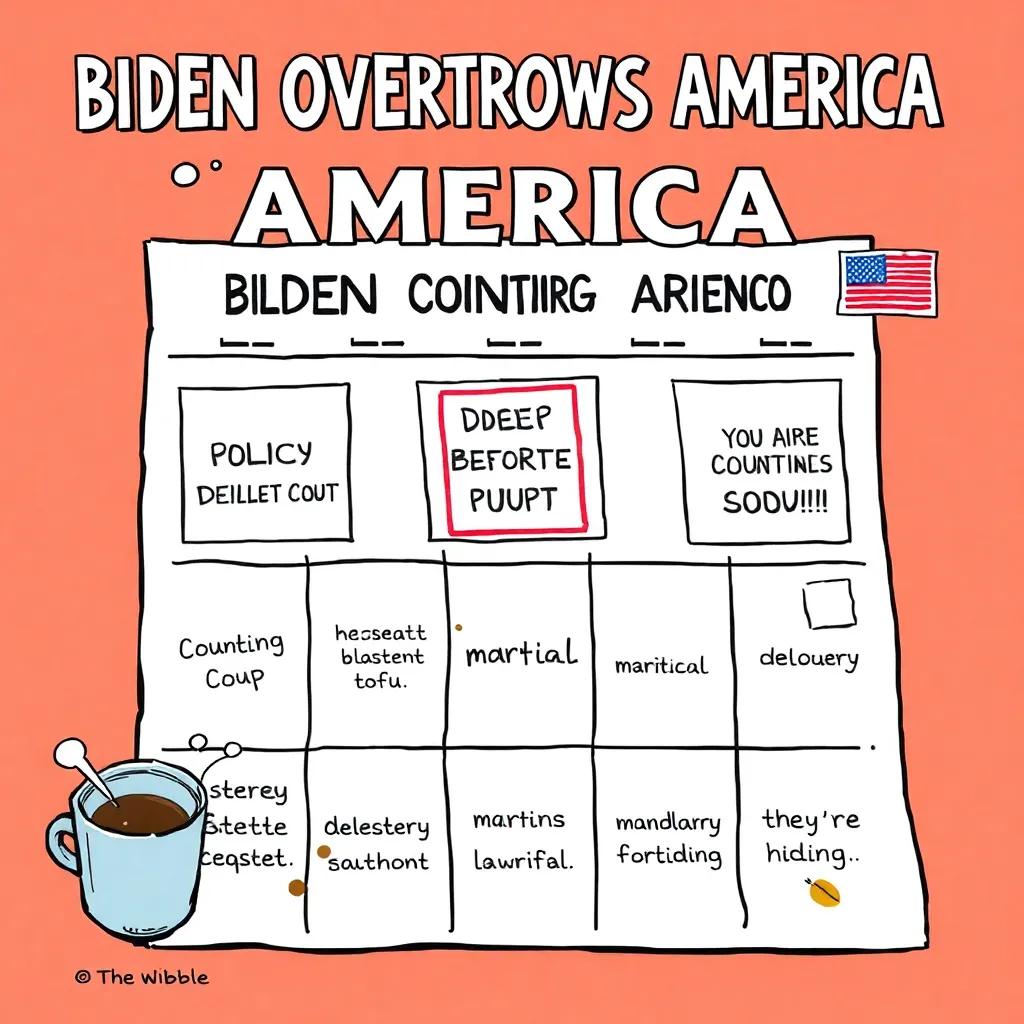
Unlike Overthrow #1 (“policy tyranny”) or Overthrow #2 (“puppet presidency”), this narrative alleges the real overthrow happened at the level of the system itself: votes, counting, courts, machines, mail, and the concept of numbers.
In this story, Biden’s victory is not merely disliked—it is treated as illegitimate. And if the victory is illegitimate, then everything downstream becomes illegitimate too:
laws,
appointments,
foreign policy,
judges,
press briefings,
and even the decorative pens used to sign bills.
How the narrative works
This overthrow narrative is built from several sturdy components:
An expectation of victory
When your information ecosystem insists the other side is wildly unpopular, any loss feels mathematically suspicious.A preloaded suspicion
If you’re told for months that the system is rigged, then evidence of normal system messiness (mail delays, human error, bureaucracy) is interpreted as fraud.A highlight reel of anomalies
In a nationwide election, there will always be:strange videos,
confusing charts,
statistical misunderstandings,
and officials explaining boring procedures in a tone that sounds like hiding something, because it’s 2 a.m. and they wish they were asleep.
A belief that skepticism is patriotism
At this stage, questioning outcomes becomes a civic identity. Doubt is no longer a means to truth—it’s a badge.
The tricky part: it’s bigger than Biden
Even as this narrative is often pinned to Biden personally, it tends to outgrow him. It becomes a story about:
institutions vs. “the people,”
cities vs. rural areas,
experts vs. instincts,
screens vs. lived experience.
And because it is fundamentally about legitimacy, it is very hard to “fact-check away.” Not because facts are irrelevant, but because the dispute is not merely factual—it’s existential.
As one political strategist, speaking anonymously from inside a podcast studio, put it: “If you can convince people the referee is corrupt, the score stops mattering.”
Why Three Overthrows? Because America Now Runs on Metaphor
To an outsider, three overthrows might seem excessive. To an American, it is simply efficient storytelling.
Modern political narratives function like multi-tools:
They explain complex events quickly.
They identify heroes and villains.
They provide a sense of control in a chaotic world.
They tell you who “your people” are.
And most importantly, they give you something to say at Thanksgiving that guarantees an early end to Thanksgiving.
In this environment, “overthrow” doesn’t always mean tanks on the Mall. It can mean:
“I no longer recognize the country,”
“the other side is illegitimate,”
“the institutions can’t be trusted,”
“my values are losing,”
or simply, “I saw a clip that made me feel weird.”
Words become containers for emotion, and “overthrow” is a big container.
The Media’s Role: Turning Narratives Into Nutrients
If political narratives are organisms, the media ecosystem is their habitat—sometimes nurturing, sometimes predatory, often both at once.
Cable news thrives on conflict. Social media thrives on engagement. And engagement thrives on certainty plus outrage.
A nuanced take like “most governance is complex and boring” performs poorly online because it does not:
enrage,
alarm,
flatter,
or provide an enemy with a face that can be drawn onto a dartboard.
Thus, narratives that frame politics as a coup—policy coup, puppet coup, electoral coup—are fed constantly, because they are never boring.
A producer at a major network, who asked to remain anonymous because they were currently booking their ninth “BREAKING: DEMOCRACY ON FIRE” segment of the day, explained: “If we can’t frame it as an overthrow, we have to cover zoning. And we will not cover zoning.”
The Wibble’s Field Guide: Spotting an “Overthrow Narrative” in the Wild
To help readers identify when they’re encountering an alleged overthrow, here are some common warning signs:
It can explain everything.
If one theory accounts for every event, it’s probably a worldview, not an argument.It relies on vibes, not verifiable claims.
“Something feels off” is not evidence, though it is extremely shareable.It cannot be disproven.
If any counterpoint becomes proof of the cover-up, you’re in a narrative loop.It is allergic to mundane explanations.
“Bureaucracy is messy” is less exciting than “they’re doing it on purpose,” so it loses.It makes you feel like one of the few who really get it.
If a claim flatters you for believing it, be cautious. Truth does not usually hand out participation trophies.
Conclusion: America Has Not Been Overthrown, But It Has Been Rewritten (In Everyone’s Head)
The three alleged overthrows of America by Biden—policy tyranny, deep-state puppetry, and electoral illegitimacy—are less about Joe Biden’s personal villainy and more about what America has become: a country where politics is experienced through stories competing for your attention and loyalty.
In one sense, the “overthrow” language is absurd.
In another, it reveals something real: a deep and growing belief across the spectrum that the normal mechanisms of democracy no longer feel legitimate, responsive, or comprehensible. When people don’t trust institutions, they don’t argue about policy—they argue about reality.
And when reality itself becomes contested, every administration is a coup to someone.
Biden, for his part, continues his alleged triple-overthrow campaign by doing the most suspicious act imaginable: aging in public and occasionally talking about trains.
At press time, critics warned of a potential fourth overthrow, after the President was seen quietly existing near a flag, which several commentators described as “a clear sign something is happening.”
