Filed Report
“The Muck Remembers”: An Exclusive Interview With the Spectateswamp Shaman at the North American Myths and Legends Expo ’86
The carpet at the North American Myths and Legends Expo ’86 had surrendered by noon.
By one o’clock it was less a carpet than a historical condition: damp with melted snow, bootprints, fennel tea, and the faint spiritual residue of thirty-seven competing prophecies. Between a taxidermied thunderbird demonstration, a panel on regional hex etiquette, and a tense autograph queue for a man claiming to be “the original Jersey Fog,” one figure held the convention floor in a silence so complete that even the nacho cheese pump seemed to lower its voice.
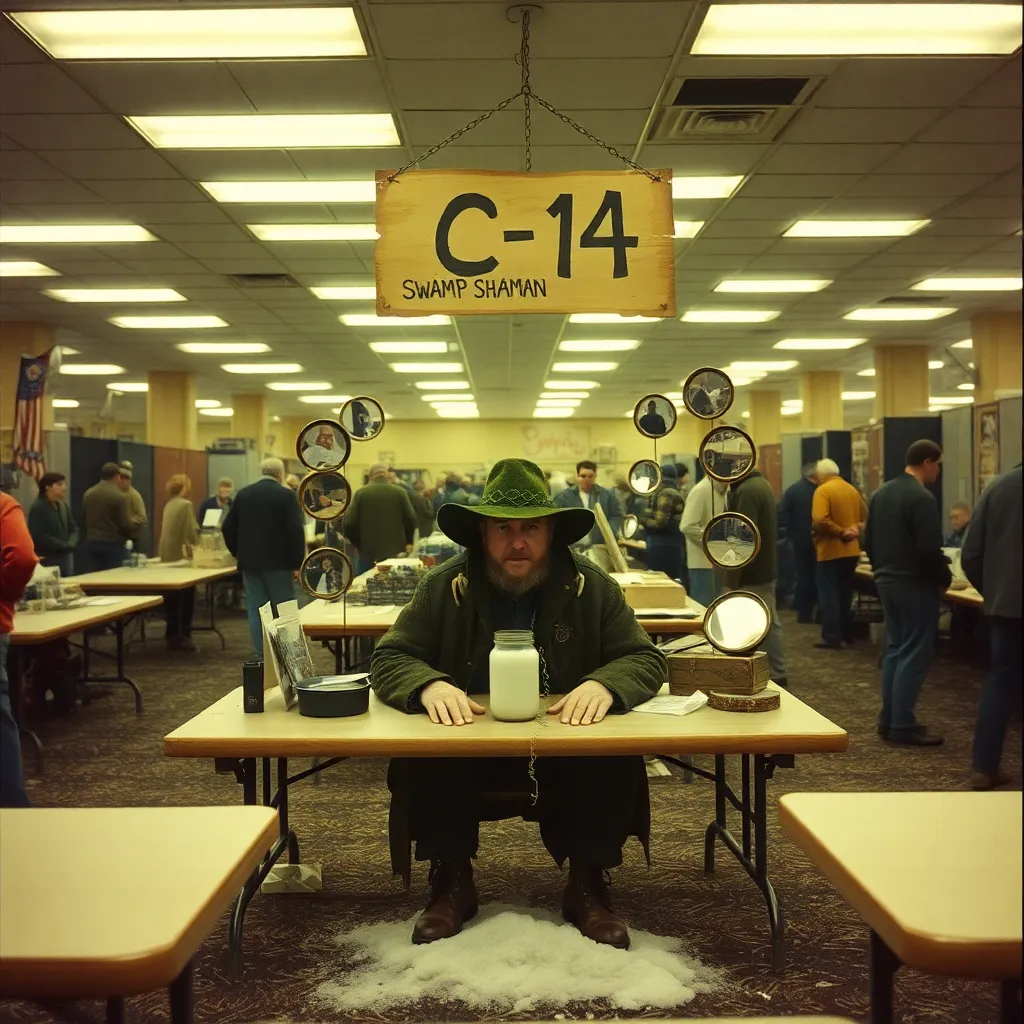
He sat in Booth C-14 beneath a hand-painted sign reading SPECTATESWAMP SHAMAN — CONSULTATIONS, BOG PERMITTING.
Nobody could agree on his age. His hat appeared to have evolved from moss. His coat was stitched with bottle caps, fish vertebrae, and what a nearby vendor described reverently as “certified wet buttons.” Around him hung dozens of tiny mirrors, each reflecting not the expo hall but suspiciously different weather. On the table before him rested three cattails, a cracked bowling trophy, a mason jar of fog, and a legal pad full of warnings written in a swamp-green pencil.
He introduced himself only by placing one hand on the table and saying, “The mud has already told you my business card.”
For readers unfamiliar with the Spectateswamp tradition, this is understandable and, according to the shaman, “probably your own fault.” Spectateswamp, he explained, is not so much a place as “a damp jurisdiction of observation,” located “three miles behind where the herons are looking.” It is a marshland known in whispered circles for producing philosophers, sinkholes, and a style of prophecy so indirect that some victims only realize they were warned years later while buttering toast.
I asked him what brought him to the expo.
“I was summoned,” he said.
By whom?
He closed his eyes and listened to a nearby cassette player where a folk duo was singing about a haunted canoe.
“By poor planning.”
This seemed plausible. The expo had already suffered two microphone hauntings, a minor antler dispute, and the unexplained appearance of seventeen folding chairs in the ornamental pond outside. Organizers, clearly desperate for stabilizing forces, had positioned the shaman between the Midwestern Beastly Relics Consortium and a retired dentist selling “wolf-resistant travel sachets.”
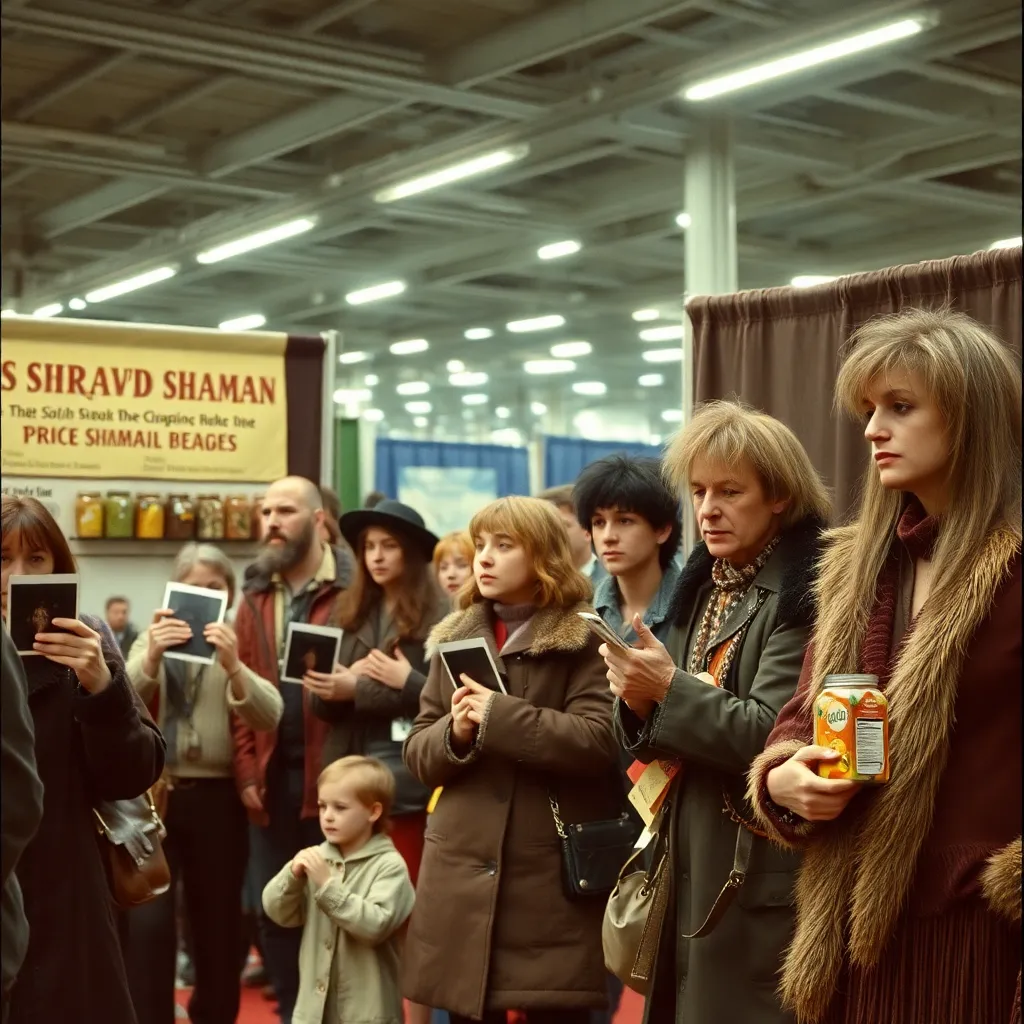
Still, his presence had become the event’s gravitational center. Attendees lined up for hours clutching Polaroids, family curses, and Tupperware containers of unidentified leaves. One woman from Duluth asked whether her basement spirit could be trained to stop humming after dark. A man in fringe demanded to know if his tax refund had been eaten by a cryptid. A child presented the shaman with a juice box and requested “the truth about puddles.”
He accepted every question with the solemnity of a judge sentencing weather.
“The basement spirit,” he declared to the woman from Duluth, “is lonely and insulted by your paneling.”
To the man in fringe: “No cryptid touched your refund. You purchased a decorative saber.”
To the child: “Puddles are windows that forgot their assignment.”
No one left disappointed, though several left transformed in posture.
When our interview properly began, the shaman insisted that all questions be asked “sideways.” Unsure how to verbally tilt a sentence, I did my best.
What, I asked, is the greatest misconception modern North America has about myths and legends?
“That they are old,” he replied instantly. “Nonsense. New legends are manufactured hourly. Somewhere right now, in a buffet restaurant off the interstate, a waitress has seen something she will never describe correctly again. By Tuesday it will be folklore. By Thursday it will have a commemorative patch.”
He glanced toward the corridor, where a Sasquatch tax attorney was hurrying past with a tray of chili.
“People think legends arrive with thunder and antlers. Often they arrive in sensible shoes and ruin county infrastructure.”
On the matter of his own reputation, the shaman was almost dismissive. Tales about him vary wildly. Some say he can read the future by examining the wakes of invisible alligators. Others insist he once negotiated a ceasefire between a lighthouse and the moon. One especially persistent rumor claims he served for a period as acting mayor of a town that no longer believes in asphalt.
He confirmed none of these stories directly.
“The problem with biography,” he said, gently rotating the mason jar of fog, “is that it encourages events.”
He did, however, elaborate on his title. Why “Spectateswamp”?
“Because ordinary swamps absorb,” he said. “Ours observes. It sees boots. It remembers lies. It knows which fishermen are singing for confidence and which are singing because they heard the reeds answer back.”
This answer caused a man standing nearby to quietly remove his fishing hat.
The shaman then offered what he described as “a brief taxonomy of wet knowledge,” tapping the table with one long fingernail for emphasis. According to him, there are five principal forms of swamp wisdom:
- Mud knowledge, which concerns history, gravity, and missing hubcaps.
- Reed knowledge, which concerns gossip, direction, and marriages that should have ended in spring.
- Frog knowledge, which concerns weather, applause, and avoidable tragedy.
- Mist knowledge, which concerns government paperwork and things with too many elbows.
- Stump knowledge, which “cannot be discussed while standing.”
At this point he became silent for nearly a full minute, apparently out of respect for stump knowledge.

I asked whether he believed the expo itself was a useful gathering of traditions or merely, as one exhausted parking attendant had put it, “a felt-lined stampede of nonsense.”
“Yes,” he said.
He then explained that expos such as this serve a vital social purpose by allowing elusive beings, amateur seers, regional fabulists, and concerned grandmothers to exchange information in a neutral environment with acceptable restroom access. “In former times,” he noted, “you had to climb a ridge at midnight and wait for a horn signal. Now there are lanyards.”
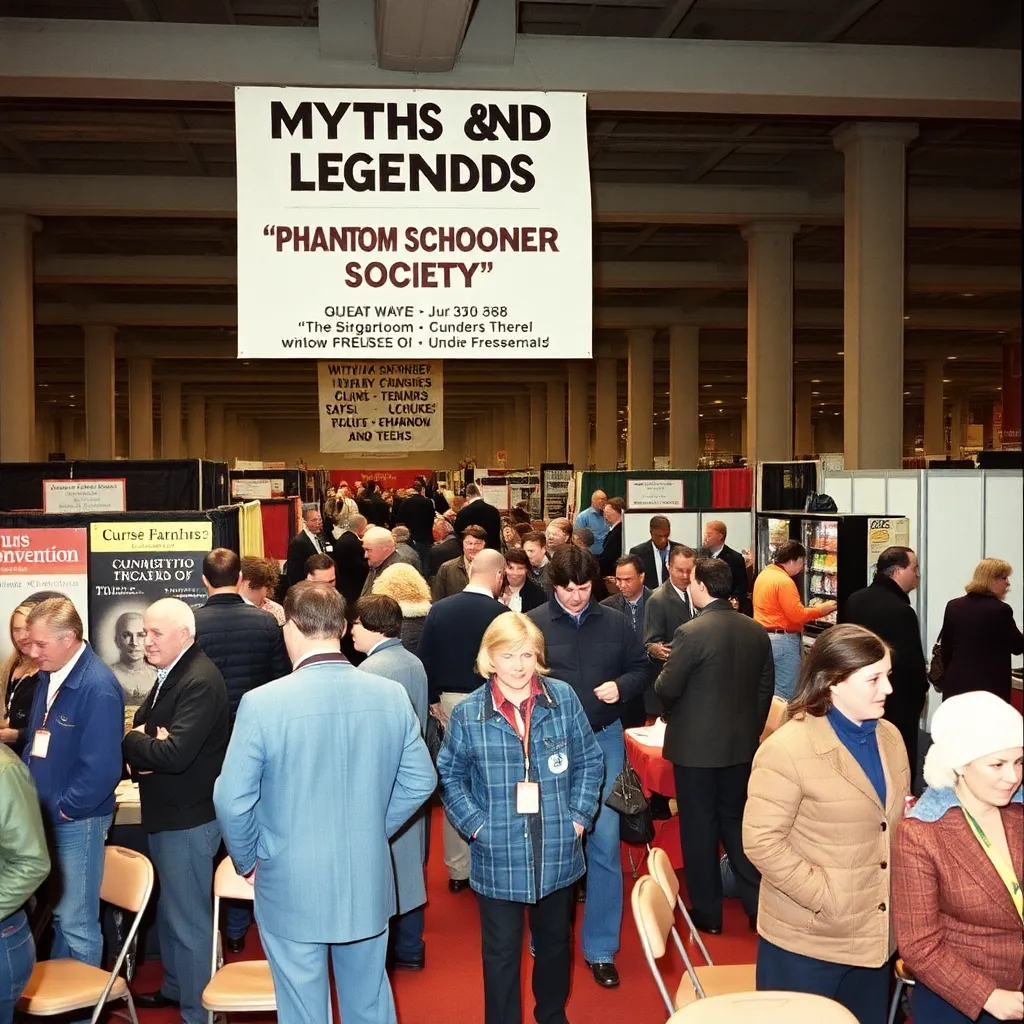
Indeed, the expo had all the signs of a thriving cross-cultural summit. In one seminar room, a delegation from the Great Lakes Apparitional Society was debating shore leave policies for phantom schooners. Down the hall, a standing-room-only lecture titled Can a Curse Be Franchise-Operated? had devolved into procedural shouting. Near the vending machines, a woman from New Mexico was teaching a knot of interested onlookers how to identify whether a howl signified danger, romance, or a promotional campaign.
The shaman watched this bustle with what could only be called paternal mildew.
“Civilization is when the mysterious agrees to table rates,” he said.
Asked about the greatest threat facing North American legends in 1986, he did not name skepticism, modernization, or the decline of handwritten warnings. Instead he leaned in and said, very softly:
“Brand consultants.”
He claimed entire creatures had been “tidied to death” by poorly conceived merchandising. Lake entities, he warned, were being forced into simplistic silhouettes. Complex roadside omens had been reduced to novelty mugs. “A regional terror requires nuance,” he said. “You cannot simply give every ancient presence a catchphrase and bright footwear.”
This complaint appeared heartfelt. He recounted, with visible pain, the case of “an excellent mire widow from the upper territories” who had been reintroduced to the public as “Splash Auntie,” complete with a jaunty logo and a line of beach towels. “She has not hexed with confidence since.”
Not all developments troubled him. He expressed optimism about younger generations, whom he praised for “bringing a welcome experimentalism to dread.” According to him, the youth of today are combining traditional cautionary motifs with fresh aesthetics, producing a wave of innovative folklore featuring reflective materials, mall acoustics, and increasingly specific elevator incidents.
“The children are doing fine,” he said. “They fear things we never even considered. This is healthy.”
At one point, our conversation was interrupted by an expo volunteer asking whether the shaman would be willing to lead the evening’s Lantern Drift Procession, after the scheduled marsh oracle became trapped in a service corridor behind a display of commemorative spoons.
The shaman considered.
“Will there be brass?” he asked.
The volunteer said there might be.
“Will there be bread?”
Also possible.
“Then yes. But no balloons. The fen despises balloons.”
Word of this decision spread through the hall with remarkable speed. Within minutes, vendors were adjusting inventory, several men with banjos materialized from nowhere, and a rumor took hold that the shaman would conclude the procession by identifying the most cursed station wagon in the parking lot. Attendance for the evening event immediately doubled.
I asked if he enjoyed celebrity.
He looked offended by the category itself.
“In the swamp,” he said, “visibility is usually a tactical error.”
Still, it was impossible to ignore his effect on people. A teenager who had initially approached Booth C-14 to mock “all this bog stuff” emerged twenty minutes later carrying a handwoven charm and speaking with great conviction about “reassessing cattails.” An insurance salesman from Ohio sat with the shaman in total silence and afterward announced he would no longer be taking Route 9 “on account of the sideways geese.” A local radio host, hoping for a theatrical soundbite, was instead told, “Your microphone is too eager,” and spent the remainder of the afternoon apologizing to his equipment.
As the interview drew toward its close, I asked the shaman the question on everyone’s mind: what, exactly, does he see ahead for the continent’s myths and legends?
He folded his hands. The mirrors around him clouded. Somewhere in the building, a decorative bell rang without enthusiasm.
Then he spoke.
“There will be expansion,” he said. “Old stories will migrate into new architecture. You will see hauntings in food courts, omens in parking structures, prophetic raccoons behind video rental shops. There will be entities in shoulder pads. There will be a period of profound confusion involving kiosks. The inland regions will produce several excellent whisperings. The deserts will continue to overachieve. The forests will remain unionized.”
He paused.
“And the swamp will watch. It always watches. Especially when you think you are merely pulling over to stretch your legs.”
This was not, I admit, comforting.
Before leaving, I asked if he had any message for readers unable to attend the expo.
He nodded and slid a square of paper across the table. Written on it in green pencil were the following words:
DO NOT ACCEPT DIRECTIONS FROM A TURKEY THAT KNOWS YOUR NAME.
I began to ask for clarification, but he had already turned to greet his next visitor, a pale gentleman carrying a lampshade and a profound expression of personal consequence.
The line behind us stretched past the cider stand and into the lobby. The mirrors rustled. The mason jar of fog dimmed as if preparing for evening. Around Booth C-14, the expo carried on in all its magnificent uncertainty: antlers, pamphlets, suspicious flutes, and the eternal hum of a continent trying to organize its mysteries alphabetically.
If the Spectateswamp Shaman had arrived because of poor planning, as he claimed, then poor planning may deserve a commendation. In a convention hall full of howling exhibits and aggressively regional doom, he stood out not because he was the strangest presence in the room, but because he seemed the least surprised by any of it.
Which, at an event like this, is as close to authority as anyone is likely to get.
<GeneratedImage prompt="evening inside a retro convention center, lantern procession gathering, swamp shaman preparing to lead attendees with banjos and paper lanterns, weird mystical energy, people excitedly looking toward parking lot, 1986 atmosphere, cinematic glow, absurd folklore realism" alt="The swamp shaman prepares to lead the evening lantern procession" />
Public Response
Comments
No comments yet.