Scientists Baffled as Humanity Continues to Buy Round Food, Store It in Squares, and Eat It as Triangles
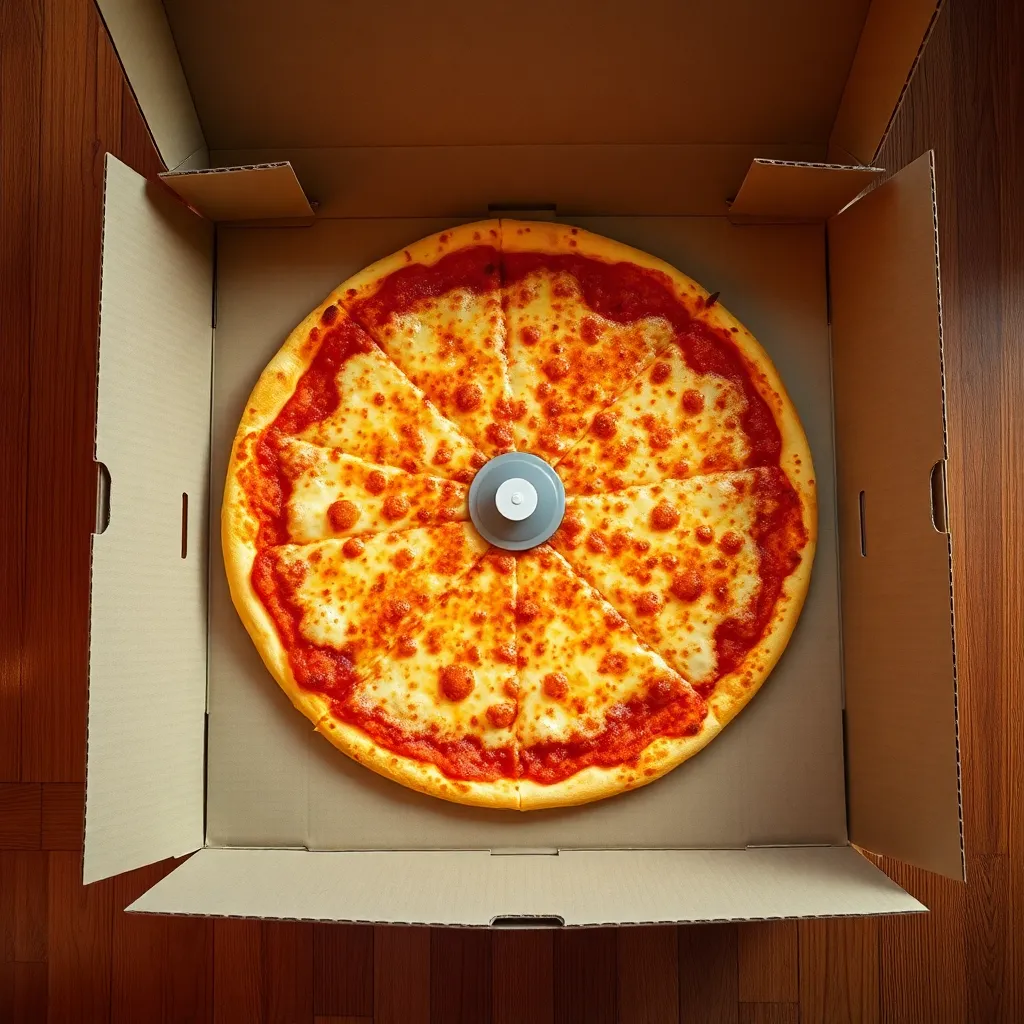
NAPLES/NEW JERSEY— In what experts are calling “either the greatest triumph of geometry or the loudest cry for help in recorded history,” researchers have confirmed that modern civilisation remains locked into the Pizza Paradox: a round product, delivered in a square container, portioned into triangular slices, and then folded into a vague crescent by people who insist they’re “eating clean.”
The revelation arrived this week after a team from the International Institute for Shapes That Don’t Match (IISTDM) published a paper titled Circular Crust, Quadratic Prison: A Study of Deliberate Spatial Confusion, concluding that pizza is “the only universally accepted proof that humans will tolerate any inconsistency as long as it’s covered in cheese.”
The Box: A Square That Knows Too Much
For years, consumers have asked why pizza is not delivered in a round box. Logistics experts immediately responded by calmly explaining that round boxes are “annoying,” “weak,” “expensive,” and “not stackable,” which is industry-speak for: we tried it once and it made everyone cry.
“Square boxes stack nicely,” said packaging analyst Dr. Carla Venn, speaking from behind a wall of flattened cardboard. “They’re cheap to make, easy to fold, easy to print on, and—most importantly—provide a large blank canvas for a phone number you will not read because you found the place on an app called ‘Food Now Please’.”
Dr. Venn also pointed to the unused corner voids inside every pizza box—four little cardboard alcoves where hope goes to die.
“Those corners are not ‘wasted space,’” she clarified. “They’re there to store guilt. That’s where you put the feeling you get when you eat the fourth slice and say, ‘I’ll just have one more.’”
The Pizza: A Circle with Commitment Issues
Pizza, being round, has long been regarded as a symbol of unity, completeness, and the eternal cycle of saying you’re not hungry and then eating half of someone else’s meal anyway.
“Roundness implies harmony,” explained cultural anthropologist Miles DeGrasse, “but pizza is fundamentally chaotic. It’s a circle that arrives in a square and immediately becomes triangles. It’s basically a geometry lesson delivered by an exhausted teenager in a hatchback.”
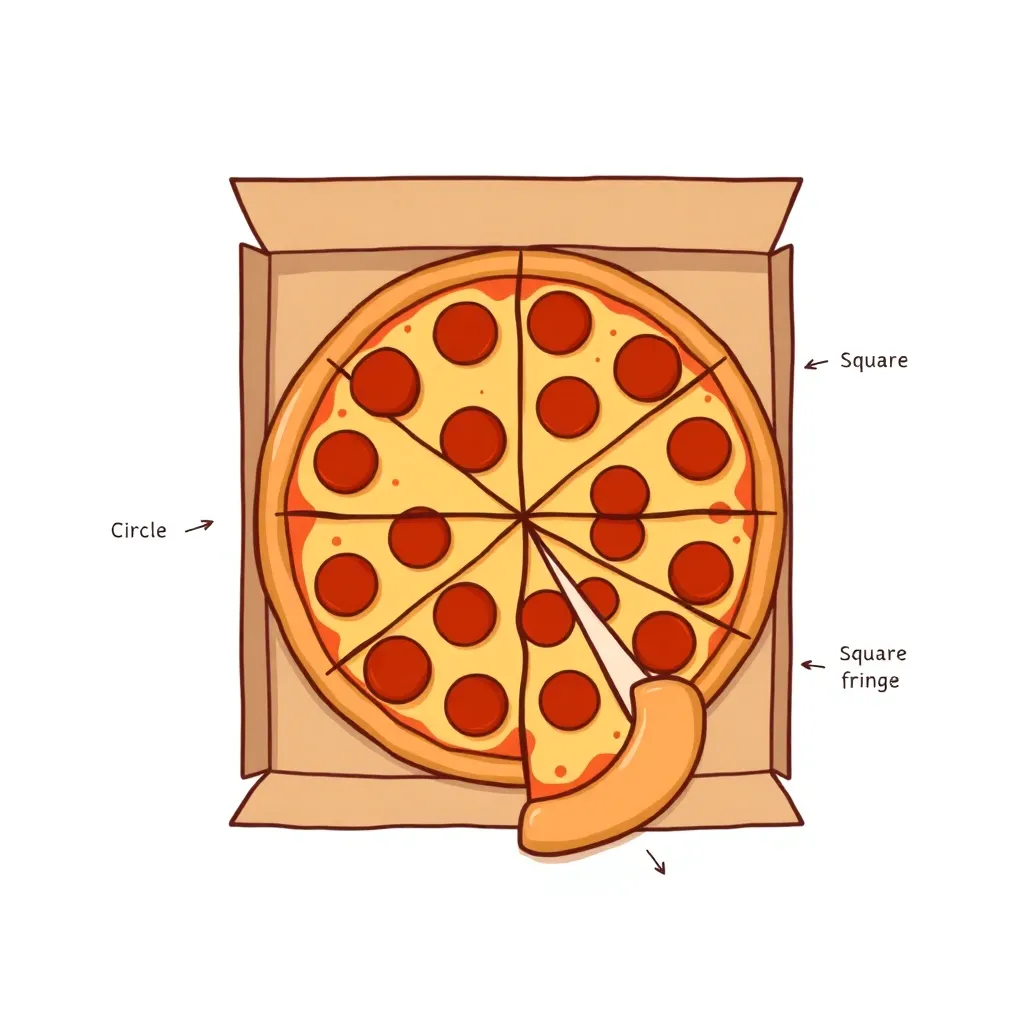
Asked why pizza is round in the first place, historians cited ancient traditions, oven physics, and the fact that “spinning dough makes it round,” while also acknowledging the unspoken truth: a circle makes it harder to pretend you didn’t eat most of it.
“With a rectangle, you can create illusions,” DeGrasse noted. “But a circle has no hiding places. It confronts you. It says, ‘Here is the total amount of your choices.’”
The Slice: Triangles, the Most Aggressive Shape
Once unboxed, the pizza is typically cut into triangles—an action mathematicians describe as “normal,” and psychologists describe as “a clear indicator that humans enjoy turning peaceful objects into weapons.”
Triangular slices offer portability, pointiness, and the opportunity to stab yourself in the roof of the mouth with pineapple. They also create that final, cursed piece: the one whose tip has been eaten, leaving a crust-only boomerang that no one claims until someone mutters, “It’ll go to waste,” and becomes the hero no one asked for.
“Triangles are the pizza’s way of ensuring conflict,” said mediator and family therapist Dr. Nina Albers. “They allow for asymmetrical slice sizes, which is essential for arguments. A pizza cut perfectly evenly can’t sustain a proper dispute.”
She added that any group pizza order inevitably follows the same emotional arc: optimism, negotiation, silent resentment, and the discovery that someone “just had two slices” but has somehow removed five.
Folded Like a Letter You Don’t Want to Read
Just when geometry thinks it has a handle on pizza—circle to triangle—humans introduce the most alarming variable of all: the fold.
New Yorkers, in particular, have developed a practice of folding triangular slices in half, transforming them into a greasy taco that drips molten regret directly onto trousers.
“It’s a structural reinforcement technique,” insisted one New York resident, speaking through a mouthful of steam. “Also, it’s how you eat pizza fast enough to survive.”
Engineers agree folding increases rigidity, creating what one paper described as “a carbohydrate beam with cheese load-bearing properties,” which is a sentence no one should have to hear in public.
Meanwhile, non-folders—primarily the rest of the planet—regard the folders with a mixture of horror and admiration, as if watching someone juggle knives “for convenience.”
The Corner Myth: “Why Not Put More Pizza There?”
The paradox has sparked repeated calls to redesign pizza itself to match the box. Several startups have attempted square pizzas, rectangular pizzas, and one doomed venture into hexagonal pizzas, which collapsed after focus groups described them as “unsettling, like edible corporate logos.”
Square pizzas do exist, of course, but they introduce a new, darker paradox: people then cut them into triangles anyway, because humans don’t want solutions—they want ritual.
“People are not eating pizza for consistency,” said consumer behaviour expert Lorna Fitch. “They’re eating pizza to feel something. And the thing they feel is usually garlic.”
As for the unused corners of the square box, some consumers have suggested filling them with extra crust, fries, or “bonus slices.” Industry representatives responded by stating this would “complicate production” and “lead to a dangerous rise in happiness.”
Economists Warn of a “Shape Recession”
Markets have also reacted to the paradox. Analysts report that pizza’s shape confusion is contributing to broader economic instability, as consumers increasingly accept incoherent systems as long as they are warm and arrive in under 40 minutes.
“If people can accept circle-in-square-into-triangle, they can accept anything,” warned financial commentator Brent Lasky. “Variable interest rates, unclear subscription fees, five different chargers for one device—pizza trained us for this.”
Indeed, pizza may be the key to understanding modern life itself: the product is simple, but the process is absurd, and the person delivering it is always somehow apologising.
A Breakthrough: One Man Suggests Cutting It Differently, Is Immediately Ignored
At the centre of the storm stands local visionary Darren Pike, 34, who claims the entire issue could be resolved by cutting the pizza into squares—“like a grid, you know, so it fits better.”
His suggestion was met with universal silence, followed by someone saying, “That’s not pizza,” despite it being literally pizza, only arranged in a way that makes sense.
Pike later reported receiving threats from traditionalists and one anonymous note that read: “Triangles forever.”
The Final Slice: Proof We’re All Just Hungry
In the end, researchers agree the Pizza Paradox is not a flaw in design but a reflection of humanity’s core values: convenience, compromise, and a willingness to pretend we’re fine with chaos as long as it comes with dipping sauce.
“Pizza is the one food that arrives as a philosophical question,” said Dr. Venn. “It asks: why is the world shaped like this? And then it answers: because you will accept it. Because you are hungry.”
At press time, a spokesperson for the pizza industry confirmed there are no plans to change anything, adding: “The system works. People keep buying it. Also, we already printed the boxes.”

Meanwhile, billions worldwide continue participating in the paradox nightly—opening square lids to reveal circles, dividing them into triangles, folding them into crescents, and briefly achieving peace before someone says the words that reset the entire cycle:
“Should we get another one?”