The Ultimate Showdown: Scientists Finally Clock The Flash, Sonic, And The Road Runner, Accidentally Invent New Unit Of Time Called “A Week”
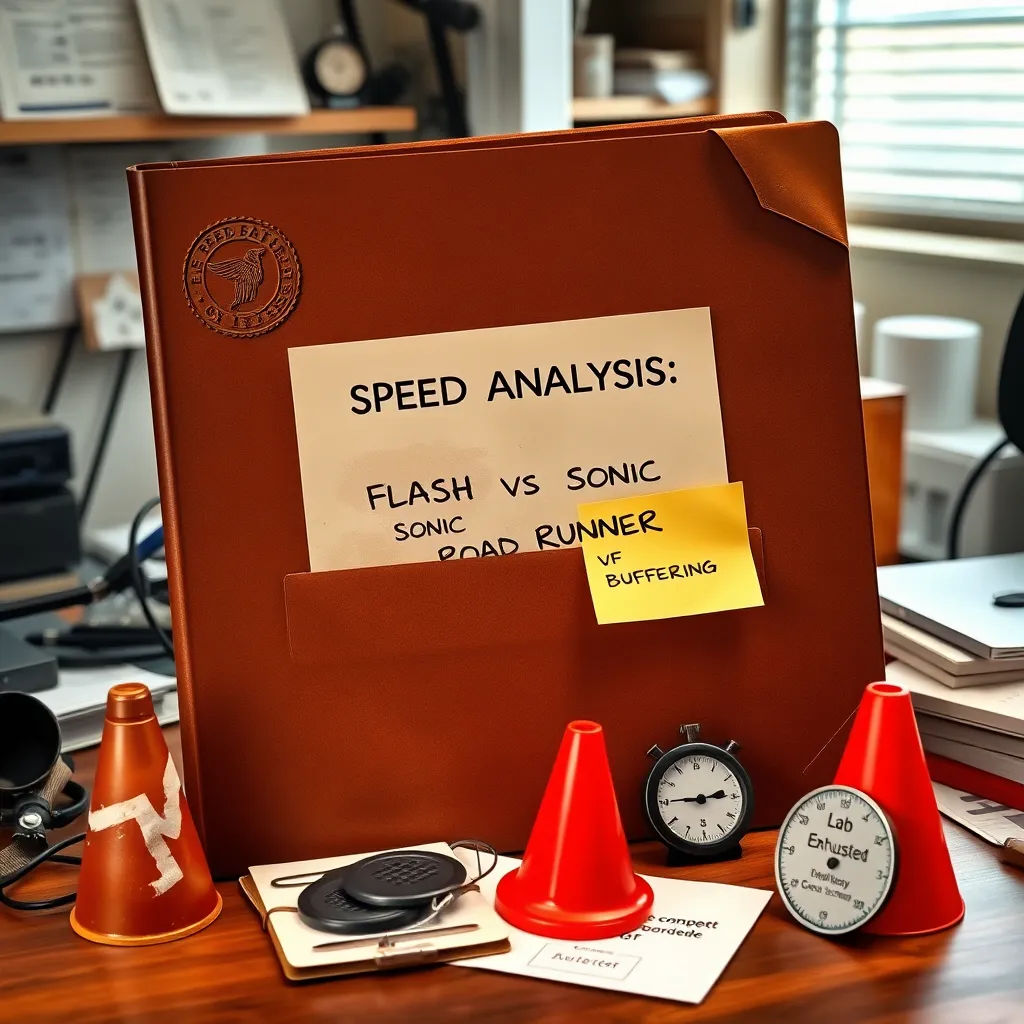
CENTRAL CITY / GREEN HILL ZONE / SOME DESERT ROAD WITH A SIGN THAT JUST SAYS “DANGER” — After decades of playground arguments, internet flame wars, and one particularly harrowing academic conference where a tenured professor shouted “RINGS ARE NOT A POWER SOURCE, THEY’RE A LIFESTYLE,” a joint task force of physicists, cartoon historians, and exhausted interns has released the most comprehensive speed analysis ever attempted: The Flash vs Sonic the Hedgehog vs the Road Runner.
The report, produced by the newly formed International Bureau of People Who Should Really Go Outside (IBPWSRGO), concludes that all three are “very fast,” with further notes clarifying: “Fast in different ways, fast for different reasons, and fast in ways that make our instruments cry.”
Methodology: Science, But With A Stop-Watch That Keeps Melting
To ensure fairness, researchers established three categories:
Sustained Travel Speed (How quickly you can get from A to B without the universe filing a complaint.)
Reaction Speed (How quickly you can notice danger and still have time to say something smug.)
Narrative Speed (How quickly you move specifically because the plot needs you to, which is the most powerful force known to fiction.)
Tests were conducted in controlled environments:
The Flash was tested in a purpose-built facility consisting of a straight line, a timekeeping array, and a therapist on standby.
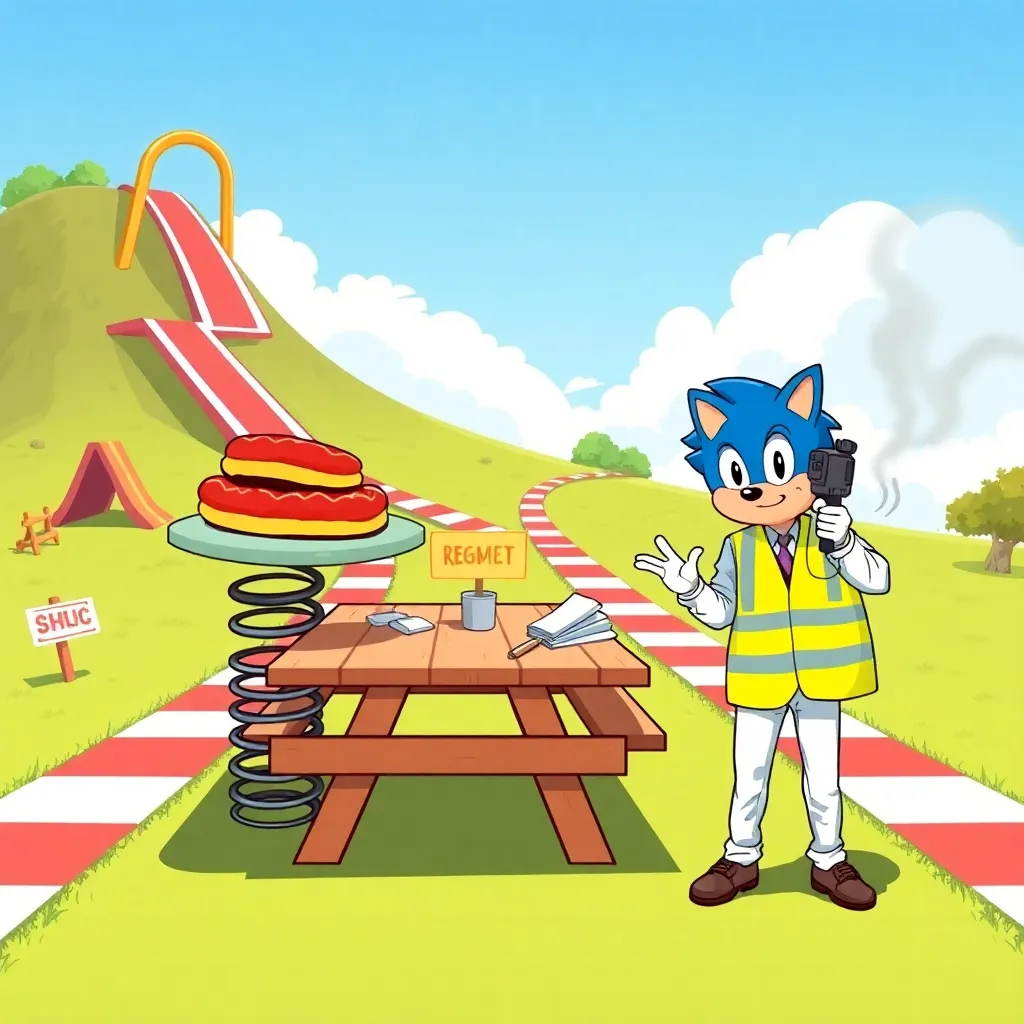
Sonic was tested on a loop-de-loop course with legally mandated ramps and a snack table stocked entirely with chili dogs and regret.
The Road Runner was tested in the desert, using a standard unit of measurement known as “the distance from one Acme product to the next.”
All three candidates were asked to sign waivers acknowledging that “speed trials may result in paradox, slapstick, or existential dread.” The Flash read it in 0.0000001 seconds and still asked for clarification.
Contestant One: The Flash, Or “Physics’ Personal Vendetta”
Claimed abilities: Near-light speed, faster-than-light in many interpretations, time travel, reality manipulation by running hard enough, and the power to make any conversation about speed instantly unbearable.
Sustained Travel Speed
The Flash’s biggest advantage is that his speed is not merely locomotion; it’s a negotiation with reality. He can run around the planet, across dimensions, and occasionally through the plot holes of his own writers.
During testing, The Flash completed a 1,000-mile sprint in a time best recorded as:
“Yes.”
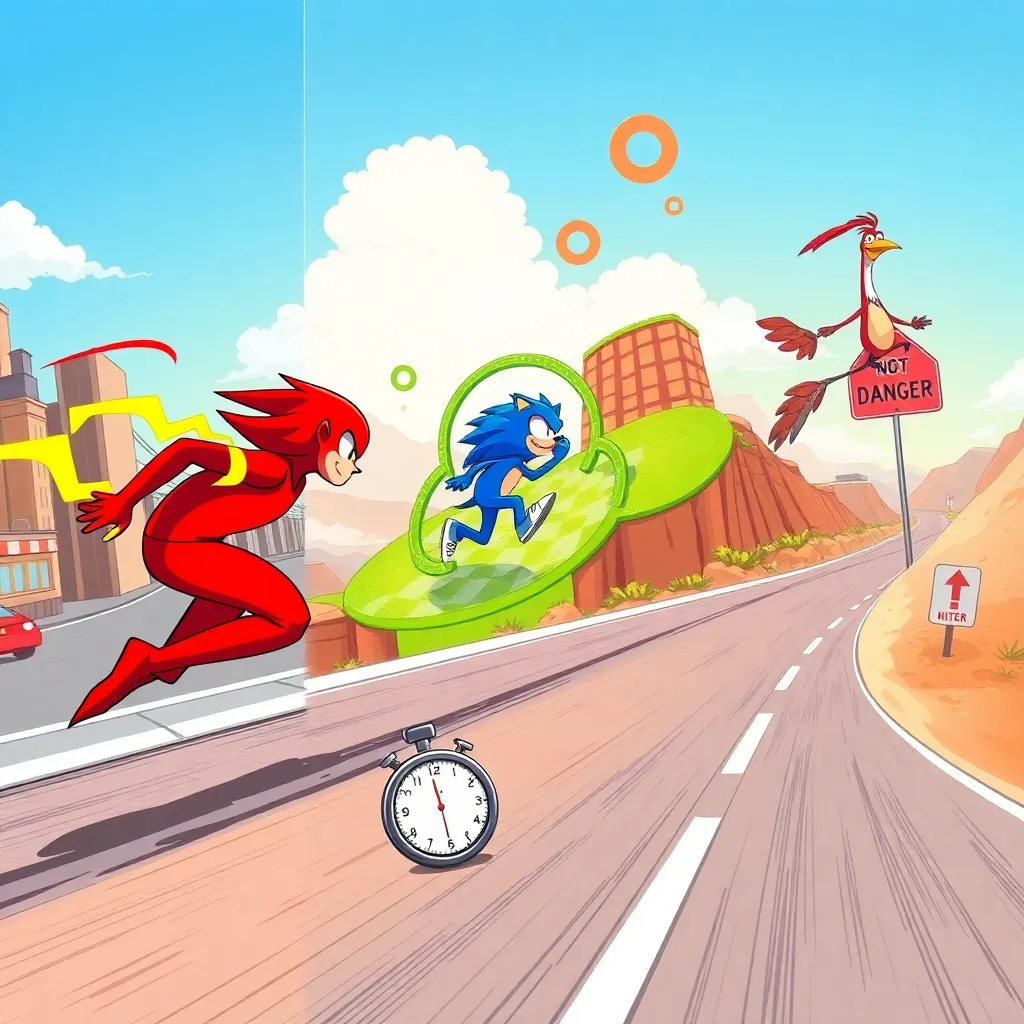
In a later run, he arrived before the starting pistol fired, at which point officials noted that the event had become “less of a race and more of a philosophical incident.”
Reaction Speed
The Flash demonstrated reaction times so fast that the lab’s high-speed cameras began capturing events that hadn’t happened yet, prompting a brief but serious debate over whether the cameras were now “clairvoyant” and therefore eligible for a union.
Weaknesses
Researchers documented two key weaknesses:
Emotional Vulnerability: The Flash can be delayed by strong feelings, especially if those feelings are expressed in a heartfelt monologue by a supporting character.
Plot-Induced Amnesia: Occasionally forgets he can solve the entire problem in 0.2 seconds, in order to give everyone else something to do.
Contestant Two: Sonic, The Blue Blur Powered By Vibes
Claimed abilities: Super speed, spin dash, air of confidence, ability to turn a casual jog into a lifestyle brand.
Sustained Travel Speed
Sonic’s speed is often depicted as extreme but not necessarily cosmic—unless he’s having a particularly “special” day and has found seven magical rocks.
In baseline form, Sonic performed exceptionally on the course, especially on surfaces that were:
Smooth
Sloped
Built specifically to let him look cool
When placed on a flat, sensible track with no loops, no springs, and a conspicuous lack of “camera-friendly geometry,” Sonic slowed slightly and asked, “Why is this course shaped like taxes?”
Reaction Speed
Sonic’s reaction time is impressive, aided by a natural instinct for danger and a deep understanding that spikes are always placed where you least want them.
However, he showed a consistent tendency to stop and taunt mid-run, as if compelled by an internal law that speed must always come with commentary.
Weaknesses
Needs Level Design: Sonic’s performance drops sharply when deprived of ramps, rings, and convenient speed boosts.
Prone To Stopping For Bits: Will interrupt a sprint to do a thumbs-up, a quip, or a brief feud with gravity.
Contestant Three: The Road Runner, Patron Saint Of “Meep Meep” And Chaos
Claimed abilities: Unspecified but absolute speed, selective immunity to physics, and the ability to humiliate engineering as a concept.
Sustained Travel Speed
On paper, the Road Runner’s speed is “fast enough to cross the screen before you can process the setup.” In practice, it is the speed of a creature that exists in a universe where momentum is optional and justice is comedic.
When officials attempted to measure top speed, the Road Runner simply moved, leaving behind:
A dust cloud
A smug “meep meep”
A clipboard that spontaneously snapped in half out of shame
Reaction Speed
The Road Runner’s reaction time is effectively instantaneous, but more accurately it’s preactive. The bird doesn’t so much react as it does exist in a state of perpetual advantage, as if it’s already read the script and highlighted the parts where the coyote suffers.
Weaknesses
Context Dependency: The Road Runner’s speed appears strongest when pursued by Wile E. Coyote. When unbothered, the Road Runner is still fast, but less metaphysically vindictive.
Moral Contract: Cannot be caught, not because it’s impossible, but because the universe would feel bad.
Head-To-Head: Three Races, Three Disasters
Race 1: Straight-Line Sprint (No Tricks, No Loops, No Cartoon Logic Allowed)
Officials banned time travel, prohibited portals, confiscated all “mysterious golden rings,” and politely asked the Road Runner to stop existing in a way that violates causality.
Results:
The Flash arrived first, second, and third, then returned to ask if anyone wanted coffee.
Sonic placed second, then demanded a rematch “on a real course.”
The Road Runner refused to participate, citing that “straight lines are for amateurs,” then ran anyway and somehow won a separate race occurring in a different desert.
Race 2: Obstacle Course (Spikes, Ramps, Traps, And A Single Anvil For Control Purposes)
Results:
Sonic improved dramatically once springs were introduced, briefly achieving a speed described as “audible.”
The Flash completed the course instantly but triggered every trap simultaneously, causing the obstacle course to become a modern art installation.
The Road Runner casually stepped around an anvil that fell upward, then caused the anvil to hit an intern’s sense of self-worth.
Race 3: Narrative Race (Judged By A Panel Of Writers Under Deadline)
Here, the competitors were assessed in the environment where they are most powerful: the story.
Results:
The Flash moved fastest, but the panel docked points because “if he did this every time, there would be no episode.”
Sonic scored highly for “dynamic visual language,” receiving bonus points for turning speed into merch.
The Road Runner dominated the category after the judges admitted, under oath, that the bird’s speed is literally “whatever is funniest.”

The New Findings: Speed Has Three Tiers, And One Of Them Is Spite
The IBPWSRGO report concludes that each character represents a different tier of speed:
Physical Speed (Sonic): Fast as an athletic feat; requires terrain, momentum, and good vibes.
Cosmic Speed (The Flash): Fast as a superpower that bends time, space, and continuity until it apologizes.
Comedic Speed (Road Runner): Fast as a law of nature created solely to ensure another creature suffers.
When asked which is “truly fastest,” the head scientist sighed and said:
“The Flash is fastest in physics. Sonic is fastest in branding. The Road Runner is fastest in meaning.”
Then the Road Runner ran by, and the scientist’s lab coat fell off for no reason.
Expert Reactions: Everyone Is Upset For Different Reasons
Fan communities responded in predictable ways:
Flash fans insisted the study was “obvious,” then demanded a follow-up where The Flash races “the concept of waiting for a Netflix buffer.”
Sonic fans argued the tests were biased against loop-based lifeforms and cited evidence from “that one cutscene” where Sonic “clearly went extremely fast.”
Road Runner fans did not engage in discourse. They simply posted “meep meep” and watched everyone else collapse.
Meanwhile, Wile E. Coyote issued a press release stating he will challenge the findings using “a new proprietary propulsion system” and “a very trustworthy rocket.” The release was printed on Acme stationery that immediately caught fire.
The Wibble’s Verdict: Who Wins?
If you define winning as:
Fastest by measurable science: The Flash
Fastest while still being vaguely governed by terrain and momentum: Sonic
Fastest in the way that matters most to the universe (humiliation): The Road Runner
Ultimately, the showdown proves what scholars have long suspected: speed is not a number; it’s a genre.
And somewhere, in a desert road that definitely wasn’t there a second ago, the Road Runner is already at the finish line—because the finish line is wherever the Road Runner decides to stand, look back, and let physics know it’s doing terribly.
Meep meep.